
Inflation, Rates, the Dollar, and War: What Really Drives the Gold Price

Introduction
Gold hit roughly $5,600 an ounce in late January. By early July it was trading around $4,050. A 28% drawdown in five months, and if you read the headlines during that stretch, you got a different explanation every week. War premium. Fed pivot. Dollar strength. Inflation surprise.
None of those headlines were wrong. They were just incomplete. Gold doesn't move on one thing. It moves on the interaction between a handful of forces, and 2026 happens to be a year where all of them showed up at the same time.
This is a plain-language walkthrough of the four variables that explain most of gold's price action, what each one is doing right now, and why the combination makes short-term forecasting close to impossible.
Real interest rates: the variable that matters most
Gold pays no interest. No dividends, no coupons, nothing. When you hold gold, the thing you give up is the return you could have earned in a safe, interest-bearing asset like a Treasury bond. Economists call that the opportunity cost, and the way they measure it is the real interest rate: the yield on government bonds after subtracting inflation.
When real rates are low or negative, the cost of holding gold is minimal. Money sitting in bonds is barely keeping up with prices, so gold's lack of yield doesn't matter much. When real rates rise, the calculation flips. Bonds start paying you something meaningful above inflation, and gold looks expensive by comparison.
This relationship is not theoretical. PIMCO found that a one-percentage-point increase in 10-year real yields has historically been associated with an 18% decline in inflation-adjusted gold. The Chicago Fed documented a similar pattern: between 2001 and 2012, real yields fell roughly four percentage points while the real gold price rose fivefold.
This is the single cleanest explanation for what happened in 2026. The 10-year TIPS real yield started the year around 1.9%. By early July it was sitting near 2.3%, a move of about 35 to 40 basis points. That might not sound like much. But in a market where gold has roughly 18 years of "real duration," 40 basis points is a wrecking ball.
The Fed under Kevin Warsh
Real rates don't move on their own. They respond to what the Federal Reserve does and, more importantly, what markets think the Fed will do next.
Kevin Warsh was sworn in as the 17th Chair of the Federal Reserve on May 22, 2026, after the closest Senate confirmation vote for a Fed chair in modern history (54-45). His first FOMC meeting came on June 16-17, and the results set the tone for everything that followed.
The committee held rates at 3.50% to 3.75%, which was expected. What was not expected was the dot plot. The 2026 median projection jumped to 3.8%, up from 3.4% in March. That flipped the implied path from one cut to at least one hike. Half the committee projected a rate increase this year. Seventeen of eighteen saw inflation risks tilted to the upside. Warsh himself declined to submit a dot, consistent with his longstanding criticism of forward guidance, and shortened the FOMC statement to roughly 130 words.
Markets entered 2026 expecting rate cuts. They got a new chair who told reporters that the commitment to price stability is "strong, unanimous, and unambiguous." The 2-year Treasury yield jumped 16 basis points after the meeting. Stocks fell. Bonds fell. Gold fell.
If you want one sentence to explain why gold dropped from its highs, it is this: the market went from pricing in a dovish Fed to pricing in a hawkish one, and gold is the asset most sensitive to that shift.
Chart unavailable
The dollar: gold's mirror image
A hawkish Fed doesn't just push up yields. It pulls capital into the United States, which strengthens the dollar. And because gold is priced in dollars globally, a stronger dollar makes gold more expensive for every buyer outside the US.
The DXY (the index that tracks the dollar against a basket of six major currencies) hit a 13-month high near 101.8 on June 24, the same day gold briefly broke below $4,000 for the first time since November 2025. That is not a coincidence. The inverse correlation between the dollar and gold has held tightly all year.
Morningstar attributes the rally mostly to the hawkish dot plot repricing, and their model suggests the dollar is roughly 15% overvalued at current levels. If that is right, any softening in Fed rhetoric could weaken the dollar and relieve pressure on gold at the same time. But "overvalued" and "about to fall" are different statements, and the dollar has stayed strong for months despite being stretched.
For savers outside the US, the dollar effect works both ways. When the dollar eventually pulls back, foreign gold demand tends to pick up because the same metal costs less in local currency. That demand puts a floor under the price, even if US buyers are sitting on their hands.
Inflation: the one everybody gets wrong
This is where most people's mental model breaks. The common assumption is that inflation is good for gold, full stop. Gold is a "hedge against inflation," so when prices rise, gold should too. Right?
Sometimes. Not always. And 2026 is the perfect example of why.
May CPI came in at 4.2% year-over-year, the hottest reading since 2023 and the third straight monthly acceleration. Energy prices did most of the work: the BLS report showed energy up 23.5% on the year, with gasoline up over 40%. Strip out food and energy and core CPI was actually a more moderate 2.9%, with core goods prices slightly declining.
Gold fell on the report.
The reason is the second-order effect. Inflation driven by an energy shock is the kind the Fed feels compelled to respond to. It pushed headline CPI to 4.2%, which made Warsh's hawkish stance look justified and raised the odds that the next move is a hike, not a cut. Higher expected rates meant higher real yields and a stronger dollar. Gold lost on all three fronts simultaneously.
This is the paradox: inflation can be bad for gold when it forces the central bank to tighten. The "inflation hedge" framing works over very long time horizons. Gold's roughly 8% annual return since 1971 includes every inflationary episode of the last 50 years. But in any given month, the direction depends on whether inflation is pushing rates up or whether the Fed is falling behind. In 2026 the Fed is not falling behind. It is leaning forward.
Geopolitics: the force that surprised everyone
The Iran war began on February 28, 2026, when the US and Israel launched airstrikes that escalated into a broader conflict. Iran closed the Strait of Hormuz, choking off roughly 20% of global seaborne oil. Energy prices spiked. The safe-haven thesis said gold should surge on uncertainty.
It didn't. Or more precisely, it surged briefly and then fell hard, because the war's primary economic channel was not fear. It was oil.
The sequence: Hormuz closure drove oil above $100. Oil drove gasoline prices up 40%. Gasoline drove headline inflation to 4.2%. Inflation drove the Fed toward hikes. Hikes drove real yields higher and gold lower. The war was bearish for gold through the rate channel, even though every instinct says war should be bullish.
The ceasefire told the same story in reverse. On June 17, a 14-point MOU was signed at Versailles, and the Strait reopened. You might expect that to be bearish for gold as the risk premium unwinds. Gold fell, but not because of the risk-premium unwind alone. The ceasefire meant lower oil, which meant lower inflation, which meant less pressure on the Fed to hike. The bullish case for gold from the ceasefire (lower rates) and the bearish case (less fear) roughly canceled each other out.
Then on July 7, Iran attacked tankers in the Strait and the US struck back. Trump declared the ceasefire "over." Gold dropped another 2%. Not because the conflict was resolved, but because renewed oil disruption revived rate-hike fears.
This is the most underappreciated dynamic in 2026: geopolitics is running through the rate channel, not the safe-haven channel. Until that changes, the old playbook of "buy gold when bombs fall" does not apply in the simple way people expect.
The floor: why central banks still matter
If the story above sounds relentlessly bearish, it is missing one piece. The cyclical forces (rates, dollar, inflation dynamics) have dominated 2026, but the structural forces have not disappeared.
Central banks bought 863 tonnes of gold in 2025, down from 2024's 1,045 tonnes but still nearly double the 2010-2021 average of 473 tonnes. Poland led with 102 tonnes. China's reported purchases were 27 tonnes, though actual accumulation was likely much higher. The World Gold Council's 2026 survey found that a record 45% of central banks plan to increase their reserves over the next twelve months.
This buying is policy, not a trade. Central banks are not watching the same charts retail traders watch. They are diversifying away from dollar reserves, a trend accelerated by the 2022 Russian reserve freeze. The dollar's share of global official reserves has fallen from roughly 72% in 2001 to around 57% today. That structural shift does not reverse because of one hawkish FOMC meeting.
The practical effect is a price floor. Gold has tested $4,000 multiple times since June and bounced every time. The World Gold Council's fair-value estimate sits near $4,100. Central bank demand does not prevent drawdowns, but it compresses them. The buyers of last resort are sovereign, patient, and not going anywhere.
Why "obvious" news disappoints
One pattern that trips up new investors: gold often falls on news that sounds like it should be bullish, and rallies on news that sounds bearish.
This is pre-pricing. Markets do not wait for events to happen. They price in the expected outcome ahead of time, and then react to the gap between expectation and reality. When the Iran ceasefire was signed, gold didn't fall because ceasefires are bad for gold. It fell because the ceasefire was already partially priced in, and the removal of uncertainty freed up capital that had been parked in safe havens.
The same logic explains why gold sometimes rallies on bad economic data. A weak jobs report can push the Fed toward cuts, which lowers real yields, which is good for gold. The "bad" news produces a bullish move because the second-order effect (Fed response) matters more than the first-order effect (weak economy).
If you are trying to trade gold based on headlines, you are always one step behind the market that already priced those headlines in. This is not a flaw in how gold works. It is how all liquid markets work. Gold just makes it more visible because the forces are so intertwined.
What to actually watch from here
The near-term picture comes down to a few specific catalysts.
The June CPI report drops on July 14. If core inflation comes in soft, September hike odds fall, real yields compress, and gold catches a bid toward $4,100 or higher. If it comes in hot, the $4,000 floor gets tested again.
The next FOMC meeting is July 28-29. Warsh hinted at Sintra in early July that inflation risks have "come down" recently. If that softening shows up in the statement or the press conference, the dollar and yields could pull back and give gold room to move higher. An explicit hawkish signal or a surprise hike would extend the pressure.
On the geopolitical side, the Iran situation remains fluid. A renewed Hormuz closure would spike oil again, but in 2026's regime, that likely means higher inflation, a more hawkish Fed, and lower gold. The only scenario where a geopolitical shock clearly helps gold is one severe enough to trigger recession fears that force the Fed to cut.
And the analyst community remains split. J.P. Morgan still targets $6,000 by Q4, though they have already cut their 2026 average forecast from $5,708 to $5,243. Goldman Sachs cut their year-end target to $4,900 from $5,400. Bank of America is at $4,360. The range of professional opinion is $4,000 to $6,000, which tells you everything about the difficulty of the forecast.
What this means if you are saving in gold
You cannot out-forecast four interacting variables. The Fed itself struggles with this. Warsh's committee raised its inflation projection from 2.7% to 3.6% in three months. If the people setting rates are recalibrating that aggressively, the idea that any individual saver should try to time entries and exits is not realistic.
The case for steady accumulation does not depend on gold going up this month or this quarter. It depends on the long-run structural picture: central banks diversifying out of dollars, US debt above $38 trillion and growing, and a 50-year track record of roughly 8% annualized returns through every rate cycle, every war, and every inflation scare in the modern era.
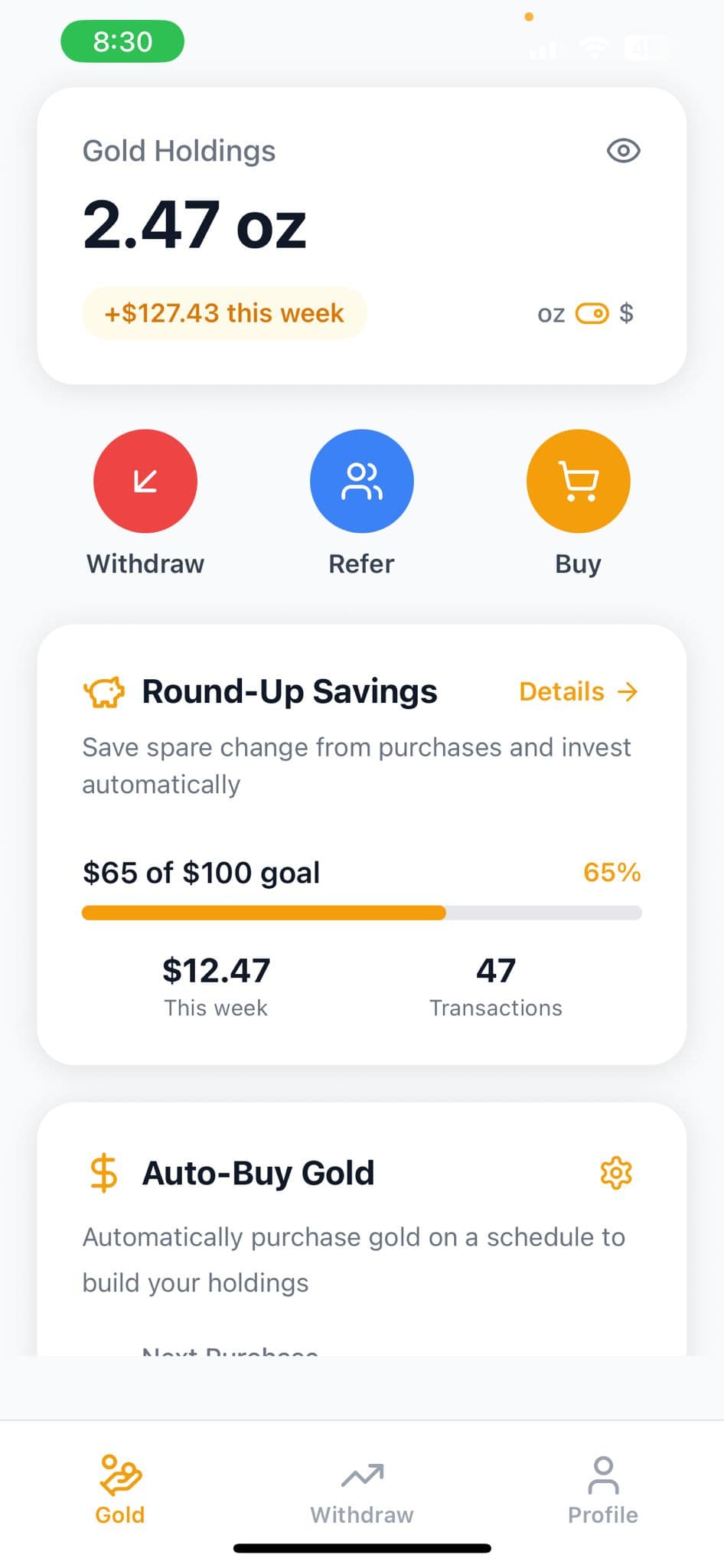
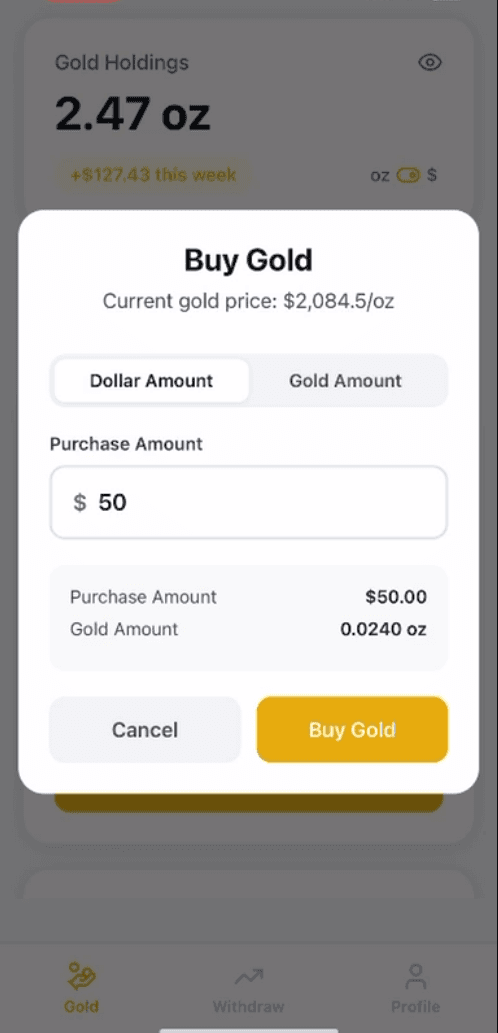
We get asked "is now a good time?" constantly. The honest answer: even the Fed cannot reliably predict what these variables will do next quarter. That is why Aure Gold focuses on habit, not timing. Set a weekly amount, let auto-save and round-ups do the work, and let the math of dollar-cost averaging handle the volatility.
The people who build real positions are the ones who stop waiting for the perfect entry and start.
Start building your gold position on Aure →