
5 Signs You Should Add Gold to Your Investment Mix


Introduction
Gold can be a smart addition to your portfolio when specific economic and financial conditions arise. Here's a quick overview of when to consider it:
- Rising Inflation: Gold often retains value when inflation erodes purchasing power.
- Market Volatility: During economic uncertainty, gold serves as a stable asset.
- Over-Concentrated Portfolio: If your investments rely heavily on stocks or bonds, gold can diversify risk.
- Currency Concerns: Gold protects against currency devaluation as its value isn't tied to government policies.
- Need for Liquidity: Gold's steady demand makes it easy to convert into cash quickly.
Platforms like Aure Gold make investing in physical gold simple and accessible, starting with as little as $10. Whether you're preparing for inflation, diversifying, or seeking a liquid asset, gold can provide stability and balance in your financial strategy.
How Does Gold Diversify an Investment Portfolio?
1. Inflation is rising and your purchasing power is declining
When inflation rises, the value of each dollar shrinks. Suddenly, that $3.50 coffee might now cost $4.25, and your grocery bill creeps higher. Even money sitting in a savings account loses ground because the interest earned often doesn’t keep up with inflation.
Cash and fixed-income investments are particularly exposed during these times. For instance, if you’re earning 1% on $10,000 while inflation is running at 4%, your purchasing power is essentially shrinking by 3% annually. Bonds face a similar issue: their fixed interest payments lose value as the cost of living climbs. This is where gold enters the conversation.
Gold doesn’t pay interest or dividends, but it tends to act differently than cash or bonds. Historically, gold prices have often risen during periods of high inflation, making it a potential hedge against the loss of purchasing power.
Take the 1970s as an example. Inflation was rampant, and gold prices skyrocketed from about $35 per ounce at the start of the decade to over $800 by 1980. More recently, after the COVID-19 pandemic triggered inflationary pressures, gold prices climbed again as investors sought refuge from rising consumer costs.
To put it in perspective, at 5% inflation, $50,000 loses about $2,500 in purchasing power annually. Allocating even 5%–15% of your portfolio to gold can help counteract this erosion, which is particularly important when saving for long-term goals like retirement.
The key is to recognize inflation’s impact early. If your expenses are growing faster than your income or investment returns, it might be time to reassess your portfolio. Gold has long been a reliable option for preserving value in uncertain times.
2. Market volatility and economic uncertainty are increasing
Stock markets rarely follow a predictable path. Some years reward investors with steady growth, while others bring sharp declines. When economic uncertainty arises - whether due to geopolitical conflicts, banking crises, or unexpected global events - portfolios can experience dramatic day-to-day swings. These moments highlight the importance of having assets that can help offset market turbulence.
Just as inflation erodes the purchasing power of money, market volatility calls for a reliable safe haven. Enter gold. During turbulent times, gold often behaves differently than stocks. For example, while the S&P 500 might drop by 20% or more during a market correction, gold frequently holds its ground or even gains value. Why? Because investors see gold as a safe haven asset - a tangible store of value that remains steady when trust in stocks, bonds, or the broader economy wavers.
Gold's relationship with stocks is defined by what experts call low correlation. Simply put, gold and stocks don’t typically move in the same direction simultaneously. When stocks take a dive, gold doesn't necessarily follow suit. This unique trait makes gold a useful tool for smoothing out the highs and lows in a portfolio.
Let’s break it down with an example. Imagine a market downturn where stocks in your portfolio drop from $100,000 to $80,000 - a $20,000 loss. Now, suppose you’ve allocated 10% of your portfolio to gold, which rises from $10,000 to $11,500 during the same period. That $1,500 gain doesn’t erase your stock losses, but it softens the overall blow, reducing the total decline in your portfolio. This kind of diversification helps mitigate risk during volatile times.
Economic uncertainty comes in many forms - political unrest, trade disputes, debates over the debt ceiling, or stress in the banking sector. These events often rattle financial markets. While gold won’t eliminate risk altogether, it reacts differently to these pressures compared to equities. Historically, when confidence in the economy falters, investors tend to shift some of their assets into gold, which has preserved value for thousands of years across various economic systems.
If you’ve noticed your portfolio fluctuating more than usual lately, or if the constant stream of alarming economic headlines is making you uneasy, it might be time to rethink your investment strategy. Adding gold to your portfolio won’t erase volatility, but it can help reduce its impact and provide stability when stocks stumble. Recognizing these patterns and adjusting accordingly is a step toward building a more balanced and resilient investment approach.
3. Your portfolio is too concentrated in stocks or bonds
Many investors stick to the traditional route when building their portfolios, focusing heavily on two main asset classes: stocks and bonds. Stocks are often chosen for their growth potential, while bonds are favored for their income and stability. But relying too much on these two options can leave your investments vulnerable. Why? Because both can experience declines at the same time. For instance, rising interest rates can drag down bond values, while recessions can cause sharp drops in stock prices - and sometimes, these events overlap.
This is where alternative assets, like gold, can make a difference. Gold has a low correlation with stocks and bonds, meaning its value often moves independently. While it doesn’t pay dividends or interest, gold serves as a reliable store of value and can help reduce overall portfolio volatility.
Research shows that adding even a small allocation of gold - around 2.5% - to your portfolio can improve its performance. For example, a study found that this small adjustment can increase the Sharpe ratio (a measure of risk-adjusted returns) by an average of 12%. Let’s say you have $100,000 invested, with $70,000 in stocks and $30,000 in bonds. By reallocating $5,000–$10,000 to gold, you introduce an asset that responds differently to factors like currency fluctuations, geopolitical tensions, and inflation.
Gold’s diversification benefits are especially valuable during financial crises. When confidence in the system falters, and both stocks and bonds tumble, gold often holds steady or even rises. This helps smooth out the extreme swings in your portfolio, creating a more balanced and resilient investment mix that can handle unpredictable economic shifts.
If more than 90% of your portfolio is tied up in stocks and bonds, it’s worth considering a 5–10% allocation to gold. This small adjustment can complement your existing investments, providing a safety net during turbulent markets and enhancing your portfolio’s overall structure.
Chart unavailable
4. You're worried about currency devaluation and long-term value
Concerns about inflation and market instability often go hand in hand with worries about currency devaluation. When the value of the dollar declines, your purchasing power takes a hit - what $100 could buy a few years ago might cost significantly more today. This erosion happens when central banks expand the money supply or when confidence in a currency falters, leading to a drop in its worth.
Gold stands apart in this scenario. Unlike the dollar, which can be printed in unlimited quantities, gold’s supply is finite. No government or central bank can arbitrarily increase its availability. This scarcity has made gold a time-tested safeguard against the effects of monetary policies that could chip away at your wealth.
Historically, gold tends to rise in value when the dollar weakens. This makes it a useful tool for protecting your portfolio from the effects of currency depreciation. By allocating even a small portion of your investments to gold, you can create a buffer against the declining value of the dollar.
For those focused on long-term goals, gold offers more than just protection against devaluation. It doesn’t corrode, expire, or rely on any single financial system for its value. Gold is recognized and valued globally, making it a reliable store of wealth. Whether you're concerned about rising government debt, increased spending, or shifts in monetary policy, gold provides a tangible asset that operates outside the traditional financial framework.
If you're uneasy about holding too much wealth in assets tied to government guarantees, adding a modest amount of gold to your portfolio can act as insurance. It’s not about abandoning the dollar - it’s about diversifying your investments to strengthen your financial foundation. Gold’s role in preserving value over the long term makes it a key component of a balanced investment strategy.
5. You need liquid assets that can adapt to changing financial needs
Life has a way of throwing curveballs - medical bills, job changes, unexpected opportunities, or surprise expenses can pop up when you least expect them. That’s why having liquid assets, those that can quickly be turned into cash, is so important.
Gold stands out as a reliable option here. Unlike real estate or collectibles, which can take time to sell, gold has a steady demand and can usually be converted to cash without much hassle. There's almost always a buyer ready, making it one of the most accessible assets in times of need.
For those who prefer paper assets, gold-backed options like Exchange-Traded Funds (ETFs) or shares in gold mining companies offer another layer of convenience. These can be traded during market hours, just like regular stocks. As Blair duQuesnay, a chartered financial analyst and certified financial planner, puts it:
"the most liquid, tax-efficient and low-cost way to invest in gold."
Physical gold, such as coins or bars, also holds strong liquidity. Nearly all the gold ever mined still exists in forms like bullion or jewelry, making it easy to reintroduce to the market. Whether you’re selling through a dealer, pawn shop, or online platform, buyers are rarely hard to find. While selling physical gold might involve steps like transport and verification, it remains a dependable option.
Modern technology has made gold even more accessible. Platforms like Aure Gold combine the benefits of owning physical gold with the convenience of digital transactions. Need quick cash? You can sell your gold instantly through an app, have it delivered securely to your home, or pick it up at a partner location. This kind of flexibility ensures you can tap into your investment whenever financial needs arise.
Some financial institutions are also stepping up with gold accounts that function similarly to foreign currency accounts. These allow you to buy or sell gold instantly, without worrying about the logistics of storing or transporting physical bars.
Gold’s liquidity, combined with its consistent demand and modern redemption options, makes it a practical choice for anyone looking to keep their portfolio flexible. Whether you’re building an emergency fund, planning for retirement, or preparing for unexpected opportunities, gold ensures your wealth is accessible when you need it the most.
How to Add Gold to Your U.S. Investment Portfolio
Diversifying your portfolio is a key strategy for managing risk, and gold can play an important role in that mix. By integrating gold through Aure Gold, you can create a portfolio that adapts to market shifts while maintaining liquidity. For the best results, consider consulting a financial advisor to determine how gold fits into your overall investment strategy.
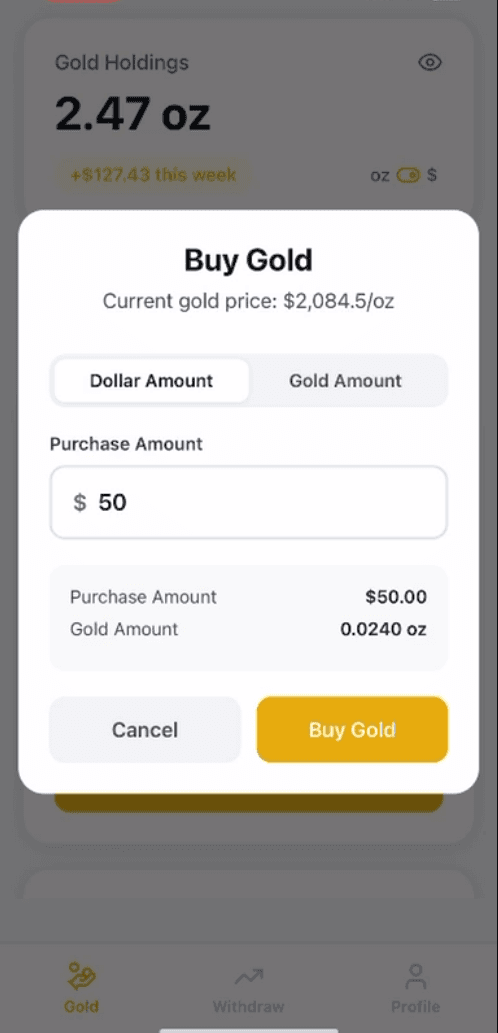
Getting started is straightforward - you can begin investing with just $10 through Aure Gold. Whether you're a first-time investor or looking to diversify further, this low entry point makes it easy to lay the foundation for a more balanced portfolio.
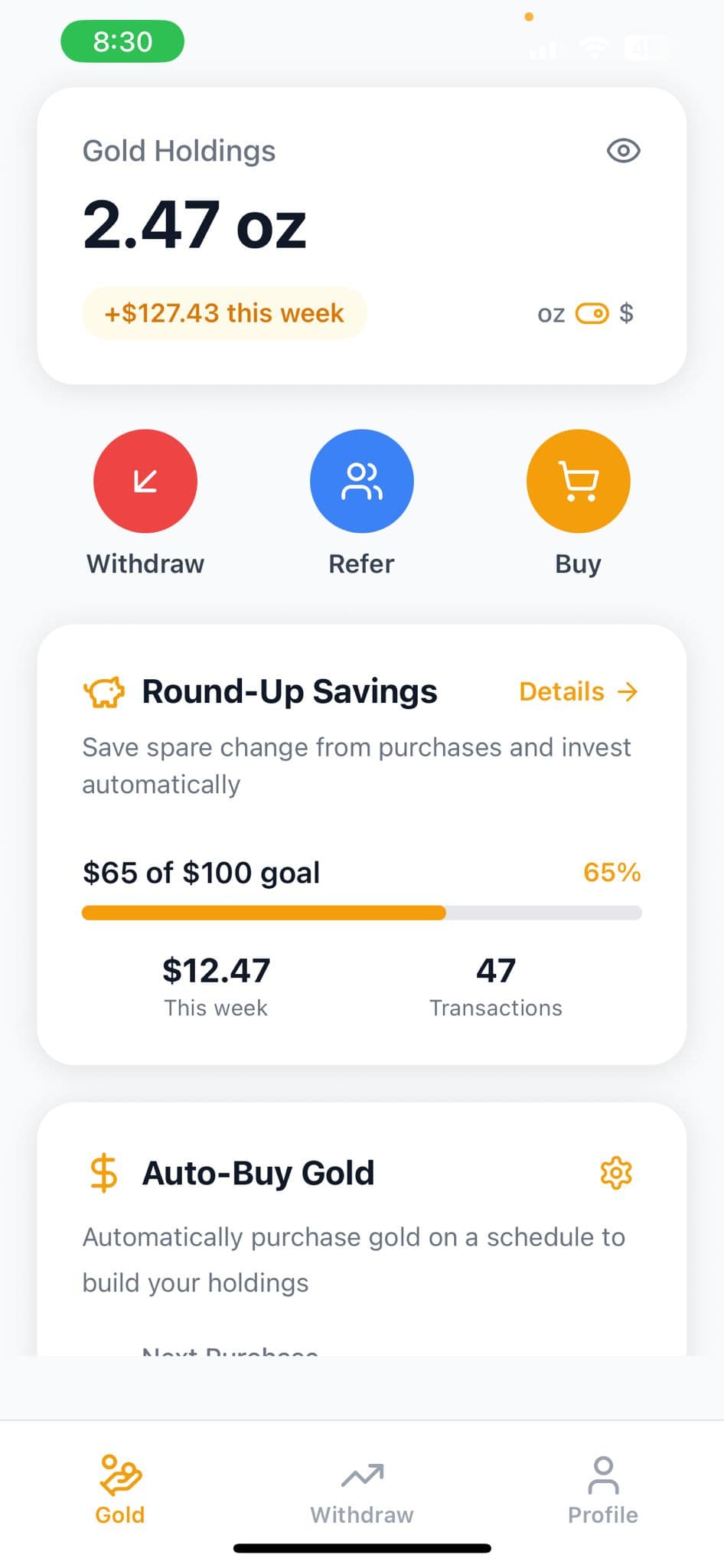
Aure Gold also offers tools to make investing convenient. You can set up automated purchases on a weekly, biweekly, or monthly schedule, or even use round-up investing from your everyday spending to accumulate gold gradually. This flexibility allows you to align your investments with your financial habits.
Once your account is up and running, it's important to periodically review and optimize your gold allocation. Reassessing your holdings over time helps ensure your portfolio remains balanced and aligned with your goals.
Aure Gold makes the process transparent and user-friendly. The platform has clear fees - 1% on transactions and 0.5% annually for storage. Your gold is stored in insured vaults with 24/7 monitoring, and the app provides real-time tracking of your holdings. You can even export performance data to help with financial planning.
When you're ready to redeem your gold, Aure Gold offers multiple options. You can sell instantly through the app, request insured delivery of physical gold, or use a partner pick-up service. This flexibility ensures your gold investments can adapt to your changing needs.
For U.S. investors, it's wise to consult a tax professional to understand any potential tax considerations related to gold investments.
Modern gold investing combines the timeless value of physical gold with the convenience of digital tools. Whether you're aiming to diversify your portfolio or build a liquid asset reserve, Aure Gold provides the resources and simplicity to make gold a seamless part of your investment strategy.
Conclusion
Gold continues to stand out as a dependable asset, especially when economic uncertainties call for a diversified and resilient portfolio. If any of the five indicators we’ve discussed align with your financial outlook, it might be time to consider how gold could enhance your investment strategy.
This isn’t about following fleeting trends - gold represents a solid foundation. It has consistently held its value through economic ups and downs, offering both diversification to reduce risk and liquidity when it’s needed most.
Now that you’re aware of these critical signals, it’s a good moment to take action. Review your portfolio and evaluate your exposure to potential economic risks. Aure Gold simplifies this process with tools like automated purchases, insured storage, and flexible redemption options. For more details on how to get started, revisit the earlier section on incorporating gold into your investments.
Including physical gold in your portfolio can help safeguard your wealth, balance risk, and provide financial stability - no matter what economic challenges come your way.