
Ignore the Price Target: Why Dollar-Cost Averaging Beats Timing the Gold Market


Introduction
Every week, someone asks us the same thing: "Is now a good time to buy gold?" It's the wrong question, and 2026 proved it.
On January 28, gold hit $5,589 an ounce. The headlines called it historic. A lot of first-time buyers took that as their cue and bought at the top.
Gold trades at $4,000 today. The people who waited for "confirmation" before entering bought near the record and are down roughly 28% five months later. The people who ignored the headlines and kept buying $20 a week watched their average cost fall every single week on the way down.
That's the entire case for dollar-cost averaging. Everything below just explains why it works.
Consider who got the call wrong. J.P. Morgan's Global Research team, some of the best-resourced analysts alive, still holds a $6,000 target for Q4 2026. They've already cut their 2026 average forecast once, from $5,708 to $5,243, while gold slid under $4,000. Their own analyst, Greg Shearer, recently described gold as an afterthought for most investors right now.
This isn't a knock on J.P. Morgan. They might be right by December. The point is simpler: even with proprietary models and decades of experience, short-term gold forecasting is hard. Hard enough that a $5,243 forecast and a $3,988 print can diverge in a few months. If they can't time it, neither can you. That was never the plan.
Run the actual numbers
Say you ran a $20 weekly gold auto-save from January through late June, about 25 weeks. Near the January 28 peak, $20 bought you roughly 0.11 grams. By late June, with gold under $4,000, the same $20 bought about 0.16 grams, close to 45% more metal for the same money. Total spent: $500. Your average cost per gram landed well below the January peak, because the math quietly weighted your buying toward the cheaper weeks.
That isn't a strategy. It's division. A fixed dollar amount buys more units at a lower price, no forecast required.
Chart unavailable
"I'll wait for a dip" is expensive
The same sequence repeats after every big run, and gold's 2026 rally followed the script exactly.
In late 2025, gold sat around $2,600. The cautious version of you said, "It's had a big year, I'll wait for a pullback." Gold didn't pull back. It ran to $3,000, then $4,000, then $5,000. By the time it touched $5,589 on January 28, with every headline screaming all-time high, those same buyers finally jumped in. The decline started two weeks later.
This is just how people react to momentum. The research is consistent: retail investors buy after prices rise and sell after they fall, the exact inverse of what works. "Waiting for a dip" feels disciplined. In practice it means waiting until FOMO beats caution, which usually happens closest to the top.
The trend is real. Most people still miss it.
World Gold Council data going back to 1971 puts gold's long-run return around 8% a year. Sit with that. The thing you're saving in has paid patient holders across five decades of recessions, rate cycles, and geopolitical shocks.
But you only collect that return if you stay in. Staying in through a 28% drawdown, through headlines calling gold dead, through the long stretches where nothing happens, is where most people break. Not because they don't get the thesis. Because they're human. Euphoria buys the top. Fear sells the bottom. The gap between what gold returned and what the average gold investor actually kept is almost entirely behavioral.
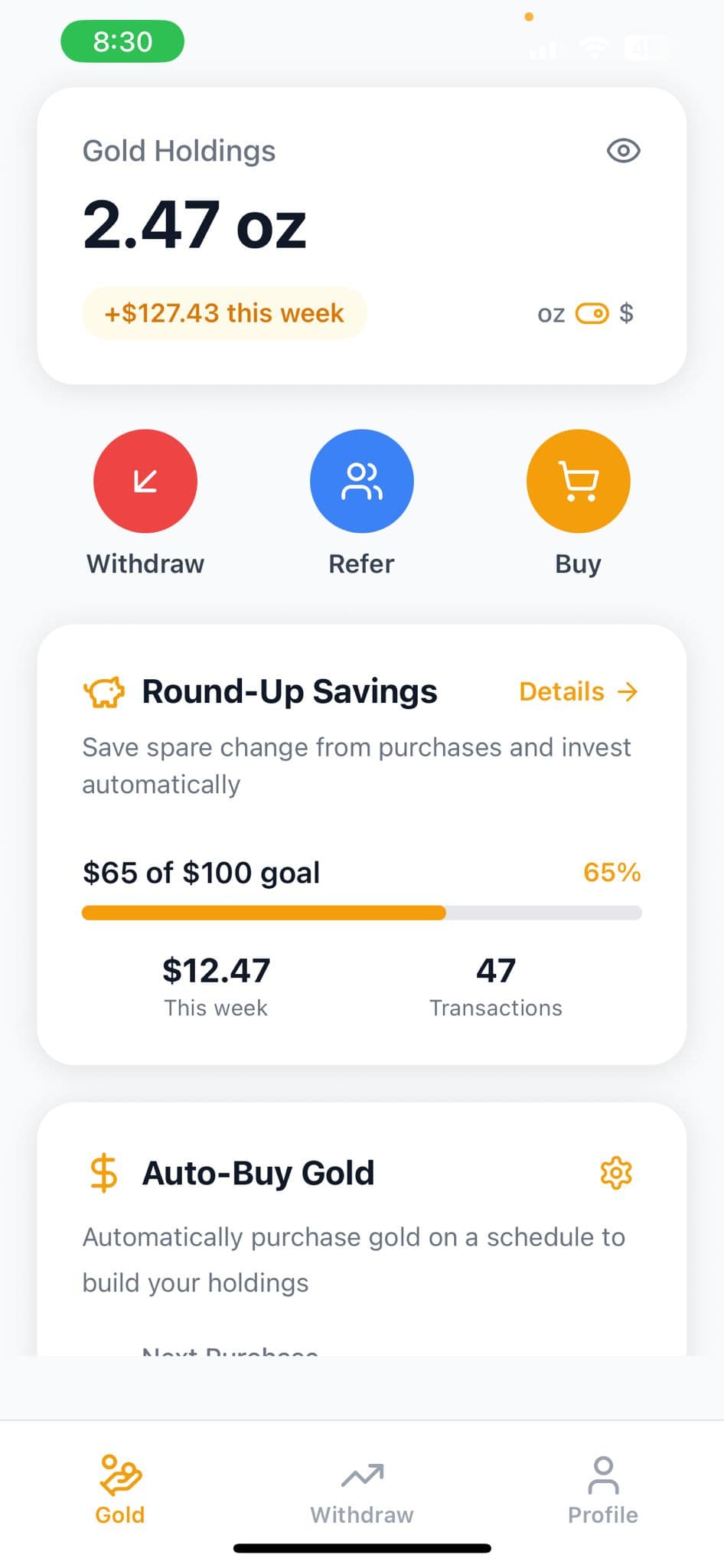
Automation closes that gap. Not because it's clever, but because it deletes the decision. You can't panic-sell a purchase that already cleared. You can't hold out for a better price when the $20 went in on Tuesday no matter what. That's what Aure Gold's auto-save and round-ups do. Not a feature, not a growth hack, just the boring mechanism the data keeps rewarding.
You can't go back and start before January. You can start this week.
How Aure makes this automatic
The hardest part of dollar-cost averaging isn't understanding it. It's doing it every single week without skipping when gold drops and the news feels bad, or pausing when it surges and you think you should "wait for it to come back down."
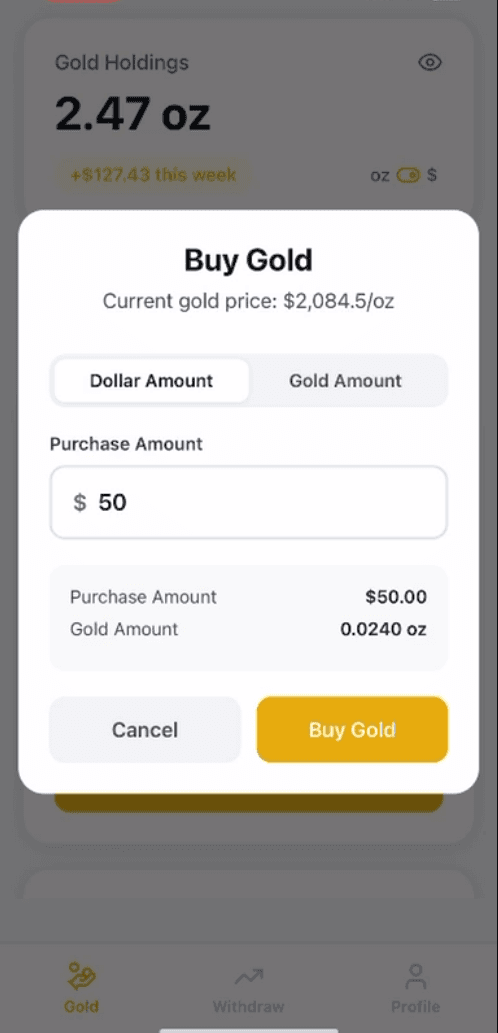
Aure's auto-save turns that discipline problem into a non-problem. Set your amount once — $10, $20, $50 a week — and it runs. Every round-up from your card purchases stacks on top. You're not making a decision each week. The decision was already made.
Your gold is held in fully allocated, insured vaults — which means specific metal is assigned to you, not pooled with other users. The spot price you buy at is the real market price, no markup hidden in the spread.
If you've been meaning to start, the account takes a few minutes. The weekly $20 does the rest.
Start building your gold position on Aure →