
Digital Gold Apps: The Next Big Fintech Disruption Nobody Saw Coming


Introduction
You’ve probably noticed something weird about your finances.
Your banking app looks better than ever. Smooth gradients, instant notifications, maybe even a cute “you’re doing great” badge. But when you zoom out, your cash is still just… sitting there. Eroded by inflation. Whipsawed by vibes. And every few months there’s another headline that makes you wonder if keeping everything in a checking account is the smartest move.
Meanwhile, gold has quietly gone full main character.
In 2025, gold blew past $4,000 an ounce for the first time and has notched dozens of fresh all-time highs, driven by a cocktail of geopolitical stress, central-bank hoarding, and investors looking for something that doesn't live or die on rate-cut tweets. Year-to-date, prices are up by more than 50%, with global institutions treating gold less like a "nice to have" and more like core infrastructure for their balance sheets, as highlighted by recent World Bank analysis on gold's rally during periods of uncertainty.
Here’s the thing: until now, that structural shift hasn’t really shown up in your everyday money stack. You’ve had neobanks to prettify cash, brokerage apps to YOLO into memes, and automatic savings apps to skim a few dollars into generic goals.
What’s missing is the next category: digital gold apps that let you route spare change and small auto-saves directly into real, allocated gold.
This is where Aure wants to live. The question is: are gold apps actually the next big fintech wave, or just hype?
1. Neobanks fixed the front end. Gold apps fix the store of value.
Neobanks were a necessary first wave. They:
- Killed overdraft fees.
- Gave you instant notifications instead of mystery charges.
- Added budgeting, payday advances, and decent UX on top of old rails.
But they didn’t change the asset. Your core balance remained fiat – a currency that can be printed, inflated, or politically weaponized. When inflation spikes or real rates crash, your beautiful app doesn’t protect your purchasing power.
At the same time, gold has shifted from "boomer hedge" to structural pillar again:
- Gold prices are on track for their strongest annual gain since the late 1970s, with 2025 prices projected to rise around 40%+ year-over-year, driven by heightened uncertainty and a weaker dollar.
- The LBMA benchmark gold price hit 13 new all-time highs in Q3 alone**, with quarterly prices jumping 16% and averaging roughly $3,450+ per ounce.
- Central banks have been buying at near-record levels since 2022, with Q3 2025 purchases around 220 tonnes, up almost 30% from the previous quarter, and full-year buying expected to land between 750–900 tonnes.
Institutions are effectively saying: “We want less exposure to any one currency. We want more gold.”
Neobanks gave you better glass on the same old balance.
Digital gold apps say: “Let’s upgrade what’s behind the glass.”
So if your banking experience feels modern but your underlying money feels fragile, are you actually as “set up” as your home screen suggests?
2. Gold just had its “Tesla moment” — and retail is underexposed
Every big market shift has a “wait, how did that get so far without me noticing?” moment.
Gold is having that right now:
- Spot prices recently traded around $4,000 an ounce, after peaking above $4,380 in October and still hovering near historic highs.
- The rally has been fueled by expectations of Fed rate cuts, rising ETF inflows, and persistent geopolitical risk.
But here’s the twist: most younger retail savers still don’t own meaningful gold.
Why?
- Physical gold feels intimidating (jewelry stores, high minimums, storage).
- ETFs feel abstract and “tradey”, not like everyday savings.
- Traditional bullion flows through old-school brokers, not everyday money apps.
Meanwhile, in other markets, we're already seeing what happens when you make "save small, stack gold" stupidly simple:
- In India, digital-gold purchases via UPI almost doubled in transaction count between January and August 2025, with total value jumping from roughly ₹760 crore to over ₹1,180 crore.
- Apps like Jar have helped millions of first-time savers build position sizes in gold using tiny, high-frequency contributions and have actually turned profitable doing it.
That’s category-creation territory: once people experience “my spare change is now gold,” it’s very hard to go back to “my spare change just sits in checking.”
So the real question becomes: why should only other markets have these rails?
3. What digital gold apps actually do (when they’re done right)
Let’s cut through the buzzwords. A true digital gold saving app should do three simple but powerful things:
3.1 Spot buying: give you a smart way to “buy the dip”
Instead of logging into an exchange and second-guessing charts, you should be able to:
- See live gold pricing.
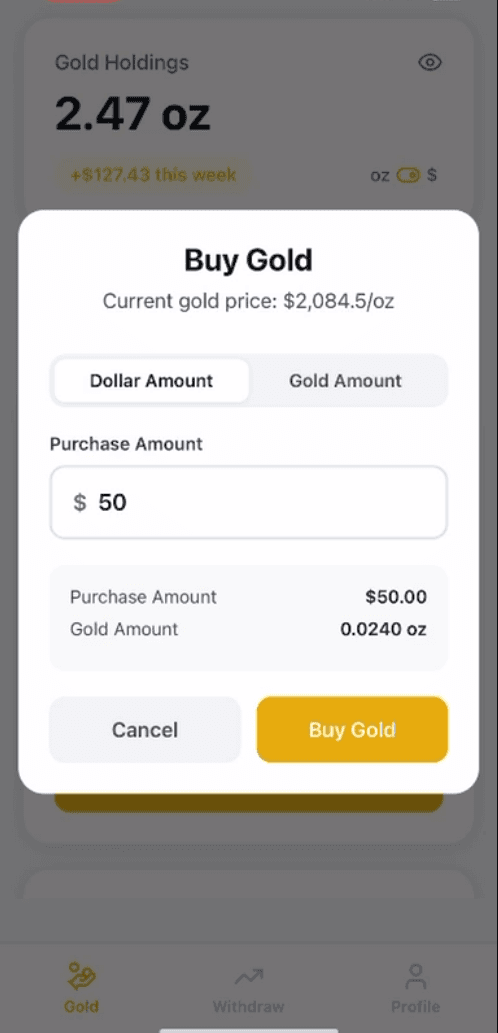
- Tap once to convert a dollar amount into real, allocated gold, not synthetic points.
- Take advantage of sharp pullbacks after big spikes (“buy the dip” moments) in a couple of seconds.
With gold swinging around key levels and reacting hard to macro headlines – especially Fed decisions and geopolitical shocks – having fast, clean spot access is no longer a "trader only" feature.
Aure’s stance: spot buying is table stakes. The differentiation is what you build around it.
3.2 Micro-savings: quietly route your “whatever” money into something real
This is where digital gold apps stop being a feature and start being a habit engine.
Think:
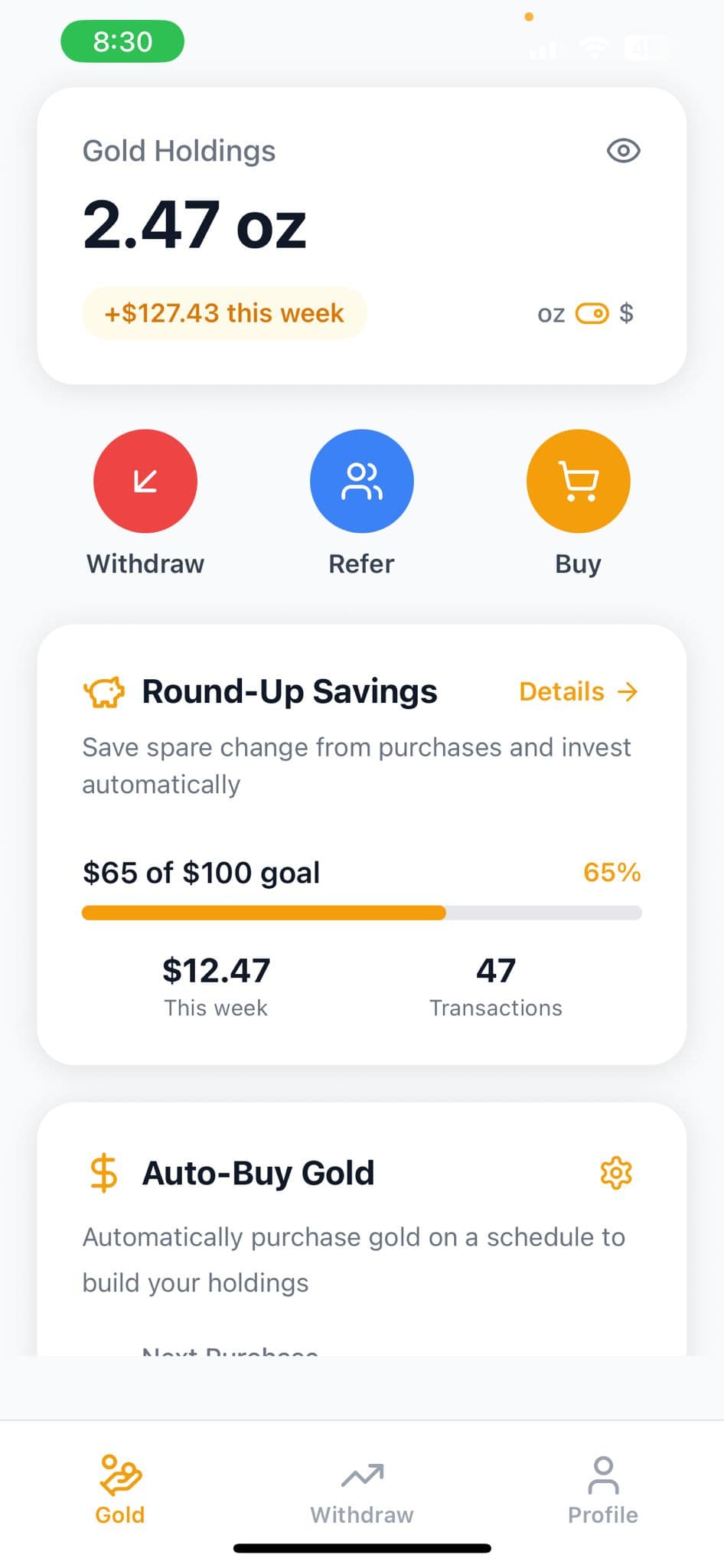
- Round up your daily card transactions to the nearest dollar and push the difference into gold.
- Set “impulse-buy tax” rules (e.g., every time you order delivery, $2 goes into gold).
- Move leftover budget at the end of the week into your gold stack automatically.
If you’ve used automatic savings apps that sweep spare change into generic cash goals, this is the same mechanic — but instead of sitting in a low-yield bucket, your small amounts are buying fractional gold, priced in grams, inside a system built around preserving value over time.
This matters most when:
- You're juggling rent, debt, and side-hustle income.
- You don't have thousands to deploy in one shot.
- You still want an asset that's been a long-term hedge against currency debasement and inflation in most historical regimes.
Aure’s goal here: make “stack a little gold every week” feel as unconscious as scrolling.
3.3 Auto-save: set-and-forget financial self-care
Real talk: most people are not going to log into a gold app daily. Or weekly. Maybe not even monthly.
That’s fine — if the system automates the right behaviors:
- Fixed recurring buys (e.g., $20 every Friday into gold).
- Stress-free “pause” and “resume” when life hits.
- Smart nudges when there’s a rare pullback after a parabolic run.
Think of this as emotional decoupling:
- You don't need to time the market.
- You just need to show up consistently with small, automated contributions.
Aure frames this as financial self-care: you set a few rules once and go live your life, knowing some slice of your income is quietly leaving the fiat rollercoaster for something historically more stable.
Where in your money stack right now do you have that level of automation into a non-fiat store of value?
4. Why Gen Z and Millennials are primed for gold apps (even if they don’t know it yet)
Let’s make this concrete with a few scenarios.
Scenario 1: The side-hustle switch-up
You’re 27, doing a salaried job plus a freelance side hustle.
- Your income is lumpy.
- Some months you crush it, others are mid.
- You’re already using a neobank and maybe a budgeting app.
Now imagine:
- Every freelance payout above $500 automatically routes 10% into gold.
- Your everyday card spends round up into micro-gold purchases.
- You see your gold grams, not just dollars, ticking up each week.
You’ve effectively turned your chaotic side-hustle inflow into a hard-asset conveyor belt — without touching a spreadsheet.
Scenario 2: The “I got burned on memes” recovery arc
You tried your luck with meme coins or momentum stocks and got wrecked.
Instead of rage-quitting investing:
- You park your main cash in a solid neobank.
- But your new rule is: “If I’m going to speculate, I also have to save.”
- So every time you move money into a trading account, Aure auto-routes 5–10% into gold.
Now, even if your trades face-plant, you're quietly building a base of something that central banks themselves are loading up on.
Scenario 3: The "I'm tired of my money melting" inflation fatigue
Your rent goes up, groceries creep higher, your savings account is… there.
You don't want to become "the finance guy" in your friend group. You just want:
- Less cash drag.
- A sense that some small part of your paycheck is being future-proofed.
So you:
- Allocate a fixed $15–$25 per week into gold via auto-save.
- Let roundups handle the rest.
- Check in once a month to see grams added, not just charts.
Over a few years, those boring, automatic contributions can build into a non-trivial gold position — even if each individual move felt almost invisible.
Which one of these feels closest to where you are right now?
Chart unavailable
5. “But what if prices are already high?” — the main objection
Let’s deal with the question in everyone’s head:
“If gold is at or near all-time highs, am I just buying the top?”
Fair concern. Here’s how to think about it without coping:
-
Zoom out, not in. Gold has gone through multiple cycles of sharp rallies, pauses, and repricings over decades. Institutions are not buying because they think it's a meme; they're repositioning reserves for a world of elevated geopolitical risk, higher debt loads, and more politicized currencies.
-
You’re not forced to go all-in at once. The offensive move with a digital gold app isn’t “YOLO $10k today.” It’s:
- Dollar-cost averaging with small, frequent buys.
- Letting roundups and auto-saves smooth your entry price over time.
- Using spot buys tactically on dips, not emotionally on spikes.
-
You’re upgrading a slice of your savings, not replacing everything. Gold is one layer in your stack — alongside cash (for liquidity) and other investments (for growth). A digital gold app just makes that layer frictionless and visible.
-
You retain control. If gold does give back some of its gains, you can:
- Pause contributions temporarily.
- Rebalance into other assets.
- Or lean in if your thesis is long-term.
So the real question isn’t “Is today the exact bottom?” but “Do I want any of my small, automatic savings flowing into an asset that institutions clearly take seriously?”
6. Why Aure is built to lead the gold-app wave
Plenty of fintechs will slap a “gold” tab into their app now that prices are on every front page.
Aure’s bet is more aggressive: gold isn’t a side quest — it’s the main storyline.
What that looks like in practice:
-
Gold-first design. The core UI is built around grams stacked, not just dollars parked. Your progress is measured in real, visible gold holdings – not some gamified points system.
-
Spot buying when you care, automation when you don’t.
- Tap-to-buy for “buy the dip” moments.
- Roundups and micro-savings to handle your autopilot.
- Auto-save rules that feel more like self-care than discipline.
-
Everyday language, not hedge-fund jargon. Blog posts, in-app education, and notifications read like a financially literate friend breaking things down — not a compliance deck. (You’re reading one right now.)
-
Future-ready rails. As gold becomes more integrated into rewards, payments, and loyalty (imagine gold-back rewards when you shop with certain partners), Aure’s infrastructure is designed to plug into that world from day one.
You’re early. That’s the point.
Conclusion: Get in before “gold app” becomes just another tab
Neobanks gave us the interface upgrade we needed.
Digital gold apps are about the asset upgrade we’ve been missing — turning “I should probably hedge against all this chaos someday” into “my spare change is already doing it for me.”
Right now, we’re still early:
- Gold is trading near historic highs.
- Central banks are quietly hoovering up supply.
- In other markets, millions of people are already using micro-savings to stack gold in the background.
The gap is everyday savers like you who want to start small, stay consistent, and not feel like a trader to own real gold.
That’s the category Aure is aiming to lead.
If this resonates, don’t wait for your bank to bolt on a lazy “gold” button and call it innovation. Join the Aure waitlist, lock in early access, and be part of the cohort that proves:
Neobanks had their moment — gold apps are next.
When you look back a few years from now, do you want to be the person who watched that shift… or the one who was quietly stacking through it?