
Custodial vs. Clear Title: What’s Actually Safer for Your Gold?

Introduction
If you’ve ever Googled “how to buy gold” and immediately felt like you’d wandered into a finance maze…same. Between vaults, ETFs, coins, and “allocated vs. unallocated,” it’s easy to bounce. But here’s the thing: how your gold is held matters as much as whether you buy it in the first place.
If you’re budgeting (hi, $20/week crew 👋) and want real, don’t-panic clarity, this guide breaks down custodial models vs. clear title ownership, why premiums and fees can quietly eat your stack, and how micro-saves plus auto-save can make gold feel doable—even in a record-high market. Oh, and yes, gold has been flirting with all-time highs this week. We’ll show you why that matters and how to play it smart without trying to time every blip. 1 2
What “Custodial” vs. “Clear Title” Actually Means (No Jargon, Promise)
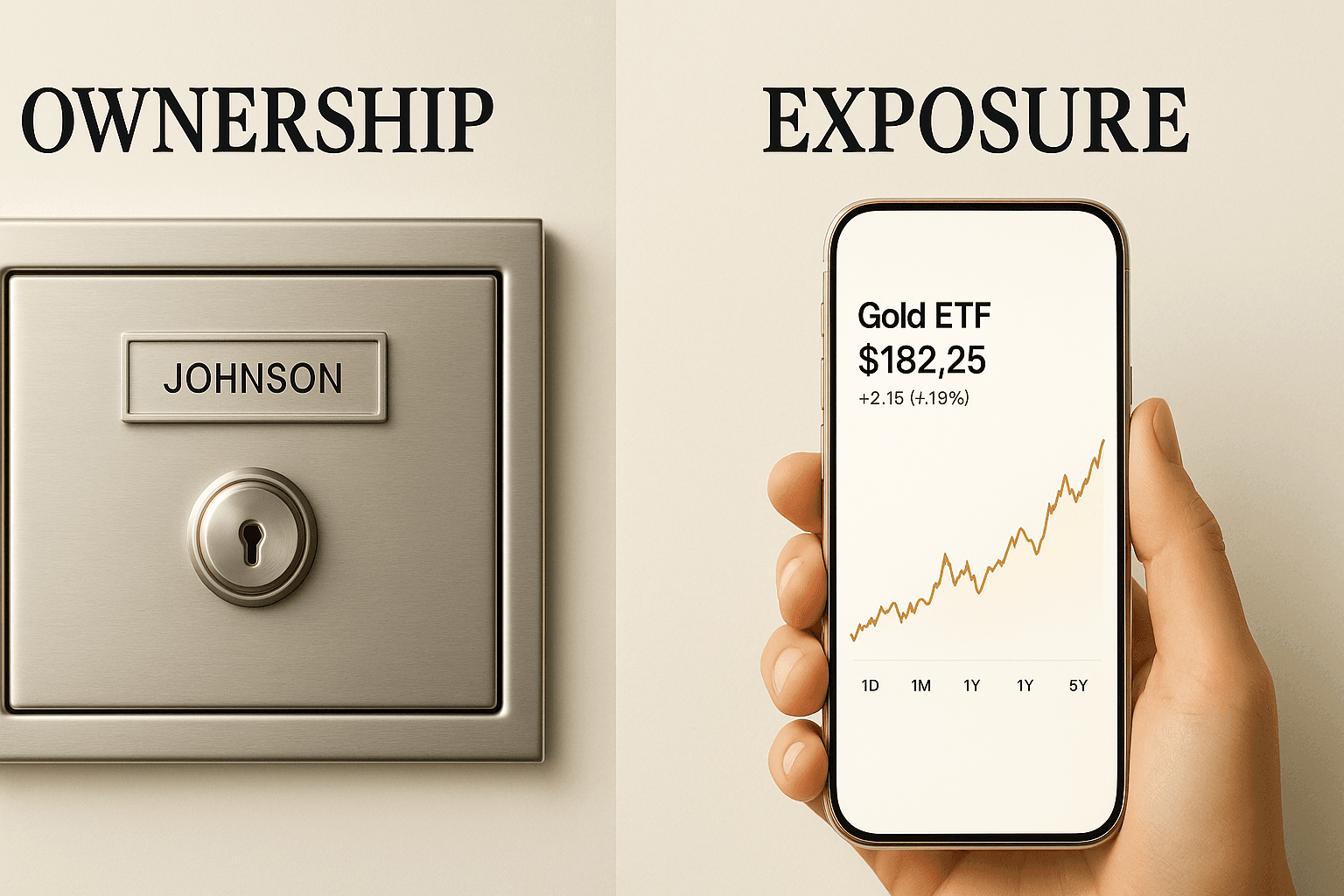
Clear title (allocated) = specific bars/coins are legally yours, recorded as your property, and segregated in a vault. If the storage provider vanished, you still own the metal. Counterparty risk is minimized because the bars aren’t on the custodian’s balance sheet. 4 10
Custodial / unallocated = you hold a claim on gold with a provider (often pooled). It’s cheaper and more liquid—but it’s ultimately a credit claim on that institution, so you take on some counterparty risk. 4 5 18
ETFs are a special case: the trust holds the gold and you hold shares. Expense ratios reduce the gold per share over time, so the fund must rise just to offset fees. You also can’t typically redeem for a single coin; you’re exposed to market price, fund expenses, and (indirectly) operational risk. 3 9
Bottom line: Clear title = strongest legal ownership. Custodial/pooled = convenience and cost savings, with some added risk. ETFs = easy ticker access, but ongoing fees and no direct bar in your name.
💡 Thinking about ownership vs. exposure? Read our deep dive on where to actually buy gold for a full breakdown.

“But Gold Is Expensive Right Now…” (Reality Check With Today’s Market)
As of Oct 2, 2025, spot gold hovered near record highs (in the $3,870–$3,895/oz range this week) as markets bet on further Fed rate cuts and navigated a U.S. government shutdown. Year-to-date, gold's up roughly ~47%—wild. 1 2 14 Futures liquidity is healthy, and positioning reflects a hot market, not a dead one. 7 6
🔥 Curious why gold is breaking records? Check out why gold is skyrocketing for the full story.
Chart unavailable
Why you care: high prices can make lump-sum buys feel scary. That’s where micro-saves and auto-save shine—stacking gradually defuses timing anxiety. If you’ve ever DCA’ed into an index fund, same vibe here.
The Three On-Ramps (Pros, Cons, and “Hidden” Costs)
1) Physically-Backed ETFs (e.g., GLD, IAU)
- Pros: Super easy to buy/sell in your brokerage; tight spreads; good transparency; large, regulated vehicles. 2 7 16
- Cons: You don’t own a specific bar; expense ratios quietly reduce your exposure over time (GLD 0.40%; IAU 0.25%). 2 3 17 You cannot typically redeem for personal 1 oz bars.
- Who it fits: If you want gold exposure inside a brokerage with a few taps, and you’re fine paying a small annual fee.
2) Bullion Dealers (Coins/Bars)
- Pros: Clear title, tactile ownership, can choose coins/bars.
- Cons: Premiums over spot can be meaningful—especially for popular coins like 1 oz American Gold Eagles (Eagles often price notably above spot due to demand/mint/distribution). Example: current retail Eagle prices ~$4,040–$4,080 when spot is ~$3,870–$3,895. Premiums vary by dealer and market conditions. 12 1 2
- Who it fits: If you value direct, hold-in-your-hand ownership and are okay with premiums and logistics (shipping, storage, resale).
3) App-Based Clear-Title Platforms (Aure’s angle)
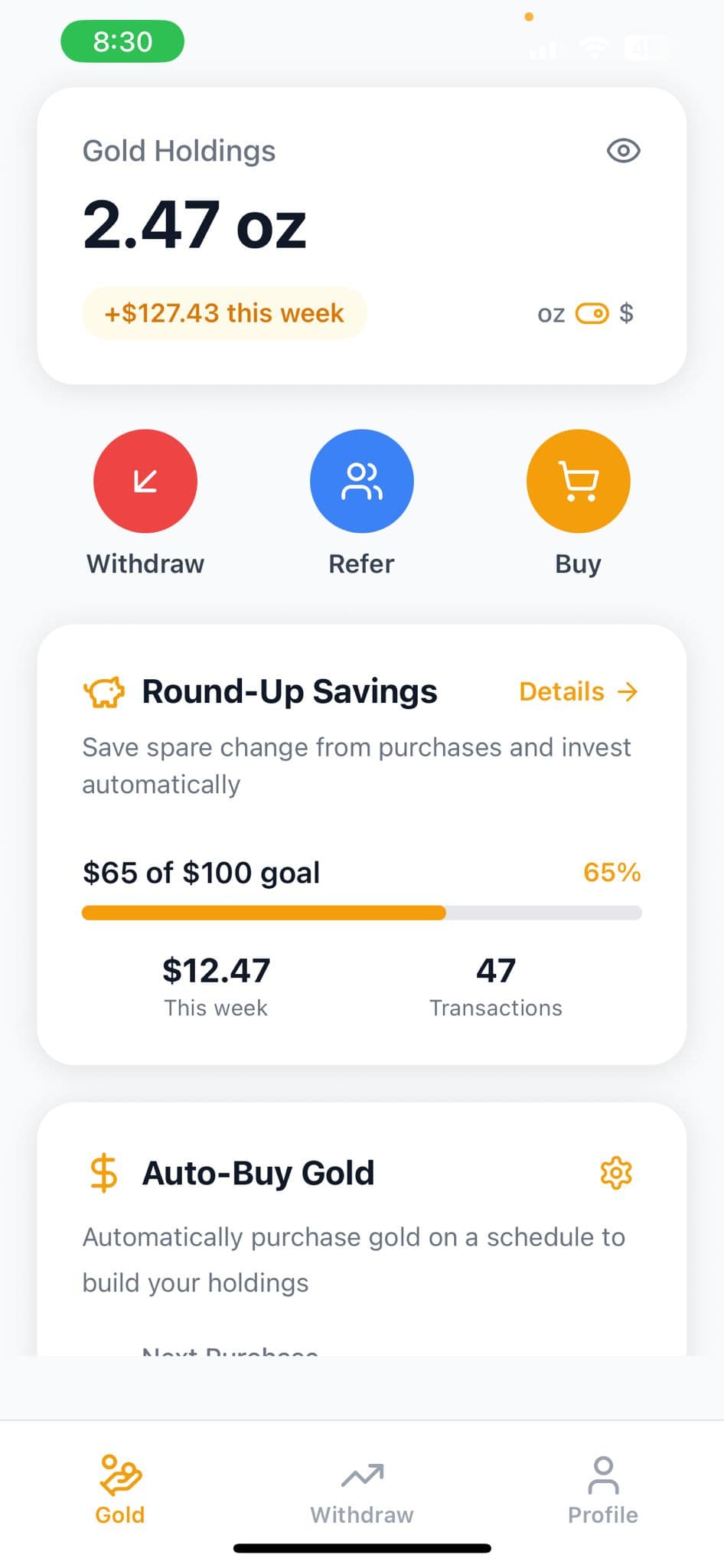
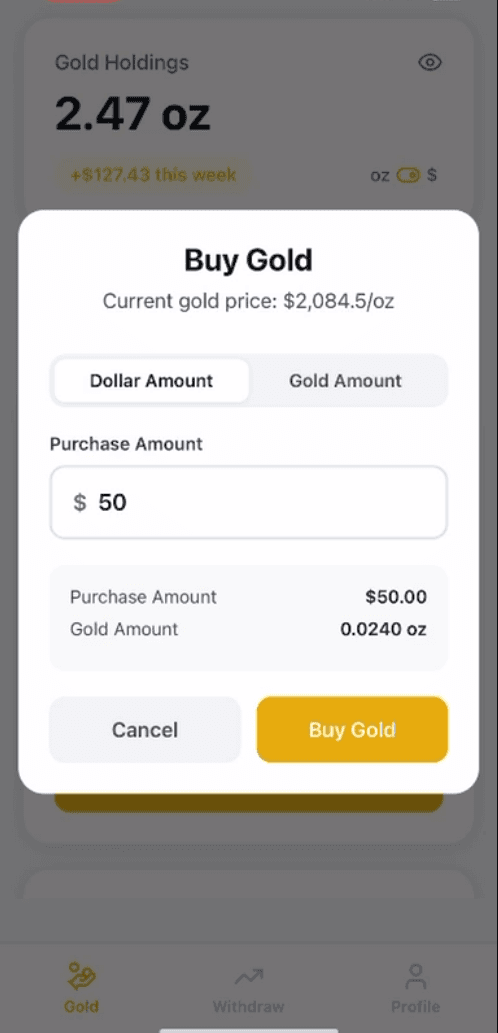
- Pros: Clear title (allocated) with modern UX, micro-saves from spare change, and auto-save ($20/week adds up); avoids ETF expense drag; reduces the premium shock of doing it all at once.
- Cons: You’ll still pay a spread/fee somewhere—good apps are transparent about it; check storage terms and audit practices.
- Who it fits: If you want legal ownership without the coin-shop chore list—and you’d rather automate small, consistent buys instead of timing the peak/trough lottery.

Custody Risk vs. Convenience: Finding Your Sweet Spot
Here’s the trade:
- Max ownership certainty: clear-title allocated storage (your bars, your legal title). 4 10
- Max convenience/liquidity: ETFs (ticker, tap, done) but pay an annual fee and accept share-not-bar ownership. 2 3 17
- Max flexibility on small budgets: micro-saves + auto-save with clear-title platforms—turn spare change into metal with less timing stress.
A mild objection you might have: “If ETFs don’t lend their gold, are they ‘unsafe’?” Physically-backed ETFs typically do not lend their gold and are designed to minimize those risks, but you still have fund expenses and no personal bar allocated to your name. Different risk, different trade-offs. 7 13
Fees, Premiums, and the Silent Erosion Problem
- ETF drag: 0.25%–0.40% annually compounds against you over years. 2 17
- Coin premiums: Eagles can run hundreds over spot in tight markets. Bars usually carry lower premiums than coins, but premiums fluctuate. 12
- What helps: Buying gradually with auto-save can smooth the entry price. Clear, posted spreads/fees (vs. "mystery math") help you compare apples to apples.
💰 Curious what actually costs more over time? Dive into our comparison of coins vs. bars vs. ETFs to see real numbers.
How $20/Week Becomes "Oh, That's Real"
- $20/week ≈ $1,040/year.
- In a high-price environment, small, regular buys reduce decision fatigue and “ugh, I missed it” vibes.
- If prices dip during your saving journey, your next auto-save scoops the dip. If prices keep running, you’re already in (FOMO cured).
Relatable scenarios:
- You meant to buy gold when it broke $2,500 but blinked—now it’s flirting with $3,900. Micro-saves get you participating without a panic lump sum. 1 2
- You love Eagles but hate the premium. Start with micro-saves in clear-title allocated form, then decide later if you want to convert part of your holdings to specific bars/coins. 12
- Your brokerage is your comfort zone. Cool—use an ETF for some exposure, but consider pairing it with a small weekly clear-title auto-save to balance fee drag with legal ownership. 2 3 17
So…What’s “Safer”?
“Safer” depends on what you want to be safe from:
- Counterparty/credit risk: Clear-title allocated storage is designed to minimize it. 4 10 18
- Execution/operational friction: ETFs are dead simple, but you pay fees and don’t hold a bar. 2 3
- Timing regret: Auto-save + micro-saves reduce FOMO and analysis paralysis—especially with prices at/near records. 1 2
Our verdict: For Gen Z/Millennial budgets and attention spans, clear-title + micro-saves + auto-save offers the best blend of true ownership and doable consistency. ETFs can complement that exposure if you love brokerage simplicity.
Coming Soon (Why You’ll Want Early Access)
We’re building an experience where you can:
- Turn on $20/week and watch your gold balance grow—no spreadsheet required.
- Own with clear title (allocated), not just a ticker symbol.
- See transparent fees and clean receipts for every auto-save.
- Optionally compare your micro-saves to an ETF “what-if” so you actually see fee drag vs. spread over time.
If you’ve ever said “I’ll start when it dips,” this is your sign: start small, start now, and let the dips come to you. 1 2
Sources
- 1 Gold hovers near record high on US rate-cut bets, government shutdown — Reuters (Oct 2, 2025) (Reuters)
- 2 Gold rallies to record high on US government shutdown and Fed rate cut bets — Reuters (Oct 1, 2025) (Reuters)
- 3 IAU Fact Sheet — iShares (Aug 2025) (BlackRock)
- 4 Allocated vs. Unallocated overview (with Linklaters) — World Gold Council (Sep 3, 2025) (World Gold Council)
- 5 Precious Metal Accounts (allocated vs unallocated) — LBMA (Accessed Oct 2025) (LBMA)
- 6 Physically-backed gold ETFs do not lend their gold — World Gold Council (Feb 17, 2025) (World Gold Council)
- 7 Gold futures liquidity and positioning — CME Group (Oct 2, 2025) (CME Group)
- 9 IAU Product Page — iShares (Accessed Oct 2025) (BlackRock)
- 10 Basel III and the Gold Market — World Gold Council (Jun 7, 2021) (World Gold Council)
- 12 1 oz American Gold Eagle Coins (pricing snapshot) — APMEX (Accessed Oct 2025) (APMEX)
- 13 Understanding Gold ETF Lending Practices — World Gold Council (2025) (World Gold Council)
- 14 Gold Price Performance Year-to-Date 2025 — Reuters (Oct 2, 2025) (Reuters)
- 16 Key Information & Sponsor's Fee (0.40%) — SPDR Gold Shares (Accessed Oct 2025) (SPDR Gold Shares (GLD))
- 17 IAU iShares Gold Trust — Expense Ratio 0.25% — ETFdb (Accessed Oct 2025) (ETF Database)
- 18 Custodial vs. Clear Title Gold Storage — World Gold Council (Sep 2025) (World Gold Council)