
Best Place to Buy Gold in the U.S. for Weekly Savings ($20/week adds up fast)

Introduction
Look, we get it—watching rent, groceries, and literally everything creep up while your savings account naps at 0-point-whatever percent? Peak millennial/Gen-Z experience. Here's the twist: while we've all been doom-scrolling, gold's been having a full main-character arc in 2025—pushing through fresh record highs near/above $3,800/oz as the market prices in more Fed cuts and headline risk piles up. 1 2 3 If you've ever thought, "I can't buy gold, I don't have thousands lying around," this one's for you.
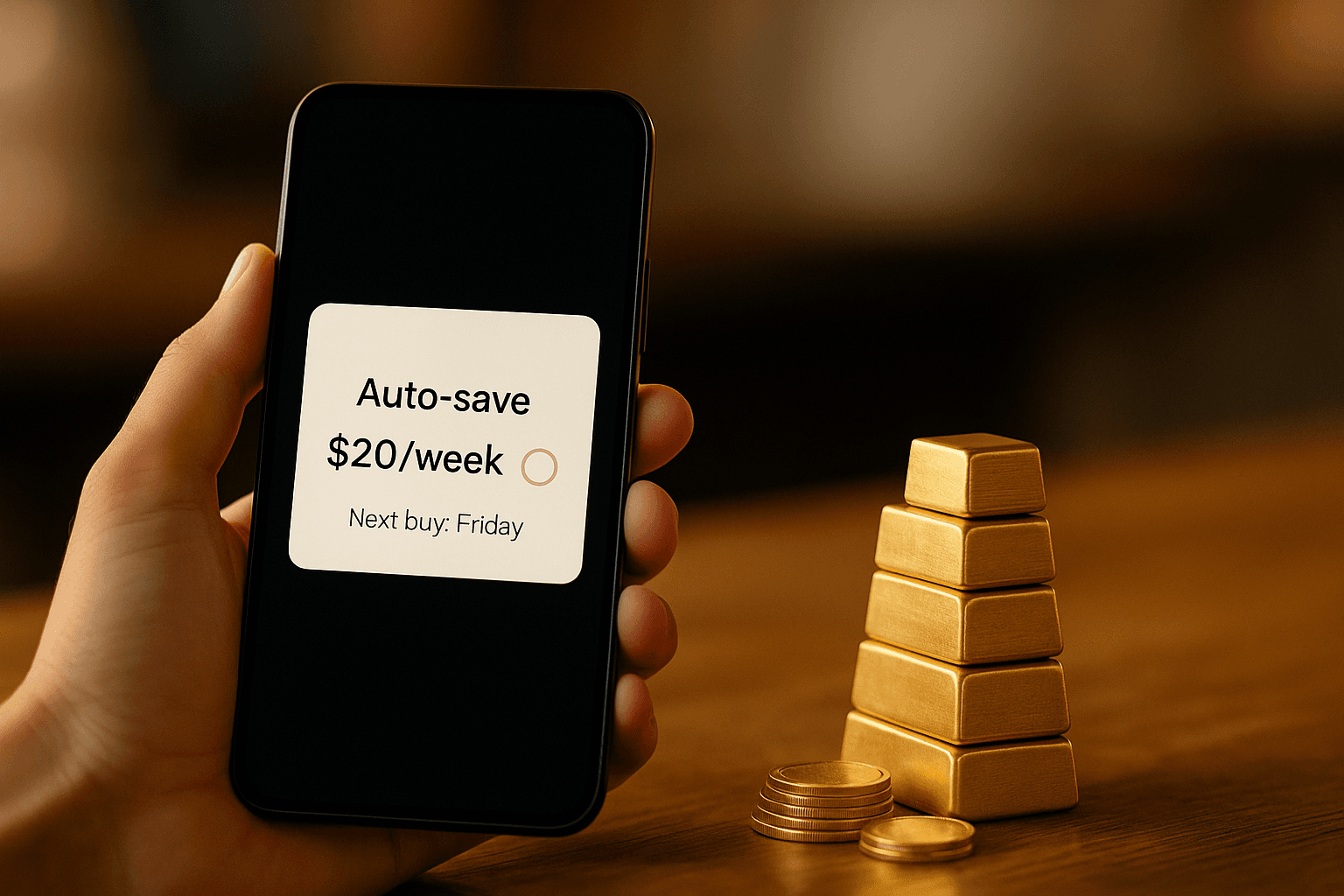
We’re going to break down where a U.S. saver putting aside $20/week can build a gold position—ETFs, local bullion shops, or Aure’s spot-buy + micro-savings model (coming soon)—and show why the low-friction, round-up, auto-save flow is a cheat code for consistency. You’ll get the latest data (no stale takes), real talk on fees, storage, and liquidity, plus a plan you can actually stick to without becoming “charts guy.” If you’ve been waiting for a sign to start small and stay steady, this is it.
Why gold is everywhere right now (and why that matters for $20/week)
Gold's not just "up"—it's breaking records. Spot and futures have traded above $3,800/oz in late September amid rising odds of more rate cuts, a wobblier labor picture, and "risk-off" headlines. 1 2 6 The Fed trimmed rates 0.25% on Sept 17 and is signaling a gradual path, which typically supports non-yielding assets like gold. 3 4 7 Meanwhile, ETF inflows and central-bank demand are reinforcing the trend—physically backed gold ETFs took in $5.5B in August, their third straight month of inflows, with September momentum building. 5 9
Chart unavailable
Here’s the thing: macro tailwinds don’t mean “ape in.” They mean start small, be consistent. That’s where $20/week shines.
Option 1: Gold ETFs (GLD/IAU, etc.) — liquid, simple… but mind the fees
What you get: One-tap exposure in your brokerage account, intraday liquidity, no storage headaches.
Why people like it for small buys: You can deploy $20 in seconds, automate weekly contributions, and track it alongside other investments.
What to watch:
- Expense ratios & spread: ~0.25%–0.40% annually, plus bid/ask spread on each buy. Fee drag compounds over time.
- Behavior tax: Easy to tinker—buy spikes, sell dips—undercutting compounding.
- Flow backdrop: 2025 flows favor direct gold exposure over miners—investors want metal, not equity risk. 6
Bottom line: Solid for brokerage natives. Just know the long-run fee drag and your own impulse to over-trade. 6
Option 2: Bullion shops & online dealers — tangible, but chunky and fee-heavy
What you get: Physical coins/bars (Eagles, 1g–1oz bars). Tangible = satisfying.
Why it’s hard on $20/week:
- Premiums: Small bars carry higher premiums over spot; on tiny tickets, premiums can dwarf contributions.
- Shipping/insurance: Repeated small orders = meaningful friction.
- Storage & security: Safes or bank boxes add costs.
- Lumpy behavior: You’ll wait and buy in $200–$500 chunks, breaking your weekly habit loop.
Bottom line: Great if you want metal in hand. For strict micro-savings, frictions make frequent small buys inefficient.
Option 3: Aure (coming soon): spot-buy micro-savings, round-ups & auto-save—built for $20/week life
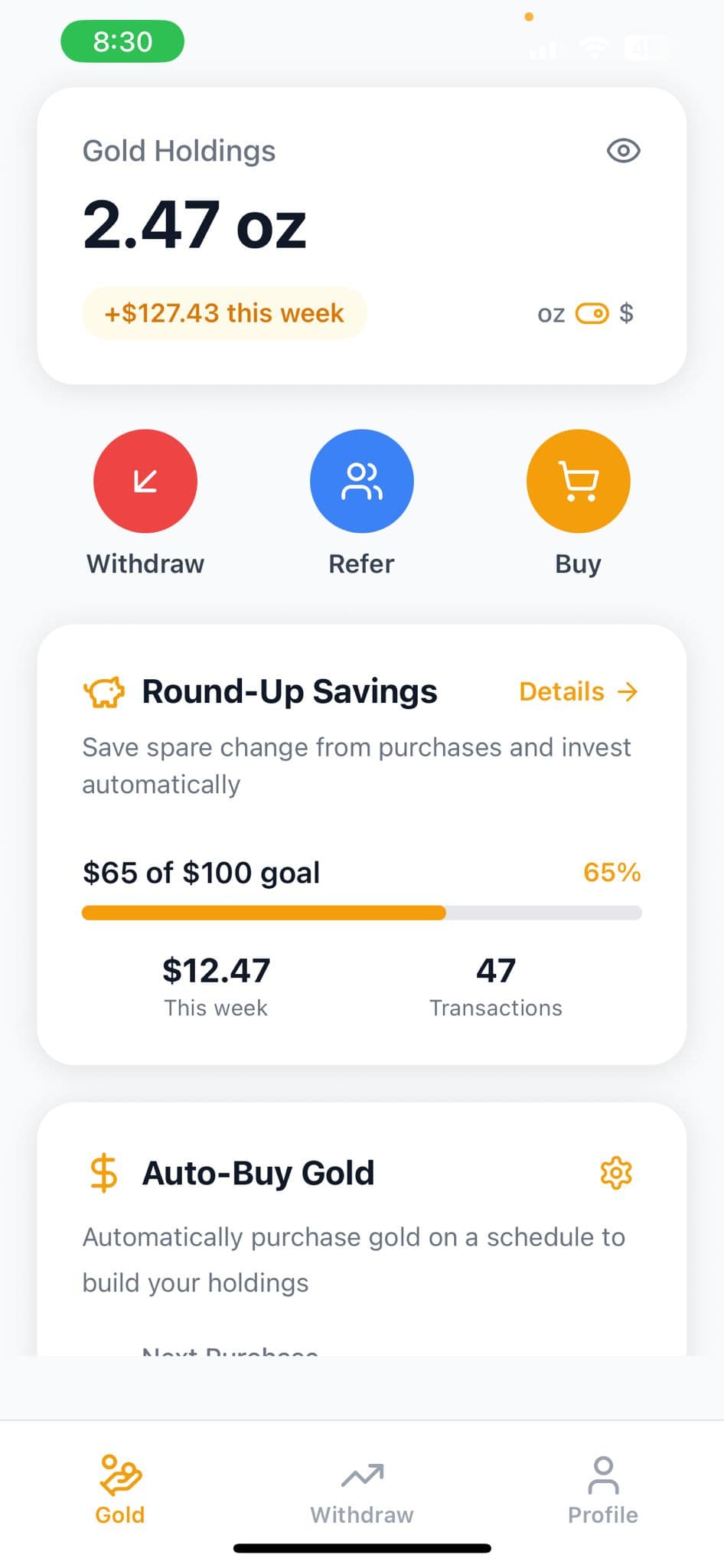
What it is: A gold savings experience designed for small, frequent contributions—round-ups from everyday card purchases, weekly auto-saves ($5, $10, $20), and spot-buying when you want to “buy the dip.”
Why it maps to 2025’s reality:
- Automate the habit: “Set it and forget it” with weekly auto-saves so you keep stacking regardless of headlines.
- Sweep your spare change: Round-ups turn transactions into incremental gold—removing the willpower problem.
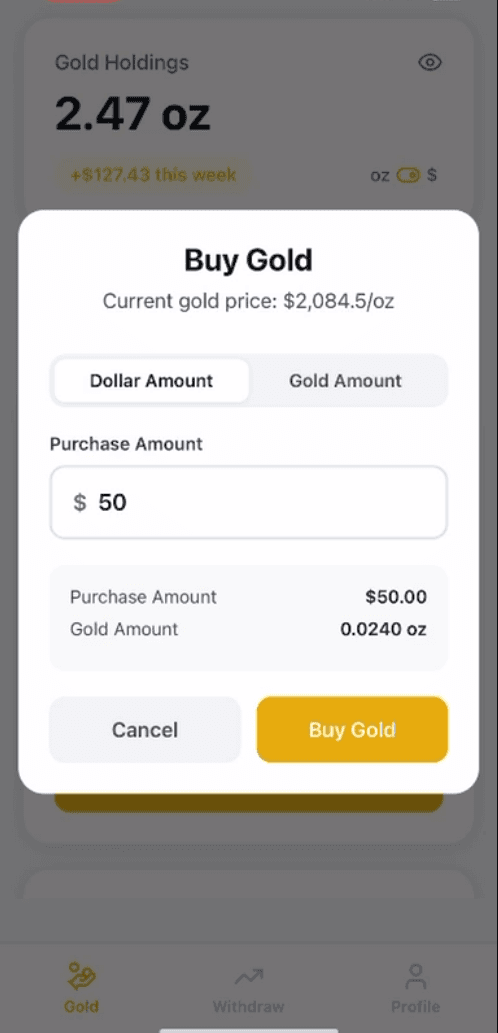
- Spot-buy opportunistically: If the Fed sounds hawkish and price wobbles, tap a quick buy—no dealer hunting or small-bar premiums.
- Transparent, small-ticket pricing: Built to minimize micro-buy friction.
- Emotion management: Add a little, often—consistency > hero trades.

Bottom line: For weekly savers, Aure’s flow is purpose-built: automate, sprinkle, and occasionally scoop dips—without the overhead of physical or the temptation treadmill of ETFs.
$20/week reality check: does it add up?
Napkin math:
- $20/week = ~$1,040/year.
- Keep that up for 5 years—even with flat prices—and you’ve stacked ~$5,200 in contributions.
- In a rising-price scenario (and yes, forecasts are just forecasts), compounding + average-down buying builds a meaningful cushion. With gold flirting with $3,800–$3,870/oz and credible houses modeling $4,000 into 2026, habit > headlines. 1 2 8

- $20/week DCA from Sept 2018 (1,200/oz) - value by calendar year. Anchored to ~Sep 2025 price ~$3700/oz
Relatable moments:
- Rent Day You: Cash is tight; your $5 round-up still happens—because it’s automated.
- Side-Gig Payday You: You toss in a $10 spot-buy after a Fed speech hinting “cautious cuts.” 7
- Market Dip You: A scary headline hits, price wobbles intraday, you add $15—emotion managed, habit intact. 1 2
Pain-point talk: fees, liquidity, and “what if I need to cash out?”
- ETFs: Great liquidity during market hours; ongoing expense ratios apply.
- Bullion: Liquid at dealers/pawn shops but spreads/premiums when selling can sting—especially for small pieces.
- Aure (planned): Designed to minimize small-ticket friction and provide app-level liquidity workflows (request to sell, transparent timeline/fees). For micro-savers, fewer moving parts = fewer surprises.
Objection: "Aren't I buying at the top?" Maybe… maybe not. Even record levels can persist in cycles with easing policy, ETF inflows, and central-bank demand—conditions we're seeing now. 1 5 8 9 The antidote to top-tick anxiety is dollar-cost averaging—which is precisely what weekly auto-save + round-ups execute.
Where ETFs, bullion, and Aure each shine (quick grid)
- ETFs: Best for brokerage natives who want intraday liquidity and automated buys. Watch the fee drag. 6
- Bullion: Best for collectors or “I want it in hand” folks making larger, less-frequent purchases to dilute premiums.
- Aure (coming soon): Best for micro-savers who want habit automation (round-ups), low-friction spot-buys, and clear small-ticket pricing—aka the $20/week crowd.
Why 2025’s macro makes automation your superpower
- Policy backdrop: The Fed's September cut and "go-slow" messaging keep the path open for easier conditions—a plus for gold. 3 4 7
- Inflation backdrop: CPI +2.9% y/y in August shows prices are still sticky. 4
- Flows & momentum: ETF inflows and "risk-off" demand show investors prefer the metal over miners this year. 5 6
- Headline risk: Funding showdowns and geopolitics add fuel to gold's "main character" energy. 1 10 11
Conclusion
If you're optimizing for consistency, low friction, and emotional sanity, Aure's micro-savings + spot-buy flow (coming soon) is the best fit for U.S. users stacking $20/week. ETFs are a fine path—just mind fees and the urge to over-trade. Bullion is meaningful if you want something you can hold, but it's clunky for tiny, frequent buys. Gold's at record levels with plausible paths higher into 2026—missing even a handful of weeks can set you back. 1 2 8 Be the first to test round-ups and auto-save when early access opens—join the waitlist and lock in your habit now. Future-you will be very, very proud.
Acronym Index
BLS — Bureau of Labor Statistics: The U.S. federal agency responsible for collecting and analyzing labor market data, including employment statistics and inflation measures like the Consumer Price Index.
CPI — Consumer Price Index: A measure of the average change in prices paid by consumers for goods and services over time, used as a key indicator of inflation.
DCA — Dollar-Cost Averaging: An investment strategy where you invest a fixed amount of money at regular intervals, regardless of market price, to reduce the impact of volatility.
ETF — Exchange-Traded Fund: A type of investment fund that trades on stock exchanges like individual stocks, allowing investors to buy shares that represent ownership in a diversified portfolio of assets.
Fed — Federal Reserve: The central banking system of the United States, responsible for monetary policy, including setting interest rates and managing the money supply.
FOMC — Federal Open Market Committee: The branch of the Federal Reserve System that determines monetary policy, including decisions about interest rates and money supply.
GLD/IAU — Gold ETF Ticker Symbols: GLD (SPDR Gold Shares) and IAU (iShares Gold Trust) are popular exchange-traded funds that track the price of gold.
UI — User Interface: The visual and interactive elements of an application or website that users interact with to perform tasks or access information.
Sources
- 1 Gold hovers near record high on U.S. government shutdown fears, soft jobs data — Reuters (Sept 30, 2025) (Reuters)
- 2 Gold price today—first open above $3,800 — Yahoo Finance (Sept 30, 2025) (Yahoo Finance)
- 3 FOMC Statement — Federal Reserve (Sept 17, 2025) (Federal Reserve)
- 4 Consumer Price Index – August 2025 — U.S. Bureau of Labor Statistics (Sept 11, 2025) (BLS)
- 5 Gold ETF Holdings and Flows – August 2025 — World Gold Council (Sept 5, 2025) (World Gold Council)
- 6 Gold and Silver Miner ETFs Go Parabolic in 2025 — ETF.com (Sept 30, 2025) (ETF.com)
- 7 Why I'll be cautious about further rate cuts — Federal Reserve Bank of Dallas (Sept 30, 2025) (Dallas Fed)
- 8 Gold forecast to rise to $4,000 by mid-2026 — Goldman Sachs Research (Sept 24–30, 2025) (Goldman Sachs)
- 9 Gold rally driven by massive ETF inflows — MarketPulse (Sept 24, 2025) (MarketPulse)
- 10 Bullion bonanza: why is gold hitting record highs? — The Guardian (Sept 29, 2025) (The Guardian)
- 11 Next Fed Meeting: When it is in October and what to expect — Investopedia (Sept 29, 2025) (Investopedia)