
Why Banks Don't Want You Buying Gold


Introduction
Picture this: You walk into your local bank with $5,000 burning a hole in your pocket, ready to do something smart with it. The teller lights up—not because they care about your financial wellness, but because they just calculated the transaction fees, the low-interest loan they can pitch you, and the monthly maintenance charges they'll quietly skim from whatever account you open. Now imagine telling that same teller you want to buy gold instead. Watch how fast the enthusiasm drains from their face.
That's not paranoia. That's business. Traditional banks have built their entire profit model around one thing: keeping your money moving through their system, where they can charge you at every turn. Gold? Gold sits still. It doesn't generate overdraft fees. It can't be leveraged for loans that earn the bank interest. And most importantly, it doesn't quietly lose value while the bank pays you a measly 0.40% APY on your savings account—a rate that's basically laughable when gold has surged over 59% in the past year alone.
Here's what we're unpacking: why your bank would rather you do literally anything else with your money, how they've designed their entire system to profit from your deposits and debt, and how Aure Gold is rewriting the rules to put you back in control.
The Dirty Truth About How Banks Make Money
Let's get real about what's actually happening with your money at traditional banks. When you deposit cash into a savings account, you might think you're being responsible. You're not. You're basically giving the bank an interest-free loan so they can turn around and make real money off it.
Banks make their profits primarily through the "net interest margin"—the difference between what they pay you for your deposits and what they charge borrowers. Right now, while they're paying you that pathetic 0.40% on average for your savings, they're charging 6.61% on auto loans and even higher rates on credit cards and personal loans. Do the math. That spread? That's pure profit, extracted directly from the gap between your financial hopes and someone else's financial desperation.
But wait, it gets better. Banks also rake in billions through fees—and we're not talking small change. In 2024, major banks collected approximately $5 billion in overdraft fees alone. JPMorgan Chase led the pack with over $1 billion in overdraft charges. Translation: They're making a fortune off people's mistakes, charging $30 to $35 every time your account dips negative.
Then there are the monthly maintenance fees, ATM fees, wire transfer fees, and about fifty other nickel-and-dime charges that slowly bleed your account. Traditional brick-and-mortar banks can charge for simply having an account, using teller services, or getting paper statements. It's like paying rent on your own money.
Here's the kicker: While you're earning essentially nothing on your deposits, banks are investing those funds in securities, real estate, and other high-return ventures. They're building wealth with your money while tossing you table scraps. And they really, really don't want you to wise up and move that money into something like gold that actually appreciates.
Why Gold Is Banking's Worst Nightmare
Let's talk about why banks hate gold with the passion of a thousand suns. It's simple: Gold doesn't play by their rules.
When you buy gold, you're removing your money from their profit-generating ecosystem. There's no interest spread to capture. No monthly fees to charge. No way to lend your gold deposits out at a markup. Gold just sits there, being gold, appreciating in value while banks watch helplessly from the sidelines.
And boy, has gold been appreciating. As of December 2025, gold is trading around $4,249 per ounce—that's up over 59% from just a year ago. Meanwhile, your savings account? Still earning that insulting 0.40%. Even the "high-yield" savings accounts that banks grudgingly offer top out around 4-5% APY, and those rates are already dropping as the Fed cuts interest rates.
The traditional banking model relies on you keeping money in their system, where it slowly loses purchasing power to inflation while they use it to generate profits. Gold flips that script entirely. It's a tangible asset with intrinsic value that has historically held strong during economic uncertainty—exactly when traditional bank products tend to underperform.
Here's what really keeps bankers up at night: Central banks are aggressively buying gold, with purchases expected to hit 900 tonnes in 2025. If the institutions that literally print money are stockpiling gold, what does that tell you about the long-term value of paper currency sitting in a bank account?
The Millennial & Gen Z Rebellion Against Traditional Banking
Something's shifting, and banks are freaking out. A stunning 72% of investors aged 21 to 43 now believe it's impossible to achieve above-average returns by investing solely in traditional stocks and bonds. Compare that to just 28% of investors over 44 who feel the same way. Young people aren't just skeptical of traditional banks—they're actively abandoning them.
Your generation gets it. You lived through the 2008 financial crisis, watched your parents struggle with debt, and graduated into an economy where everything is becoming a bank—from your landlord offering you a loan to pay rent, to your grocery store pushing "buy now, pay later" schemes. You've seen how traditional financial institutions profit off desperation, and you're not here for it.
Bank of America found that 45% of wealthy young investors already own physical gold, with another 45% interested in acquiring it. That's not random. It's a conscious choice to opt out of a system designed to extract value from you. You're choosing assets that banks can't control, manipulate, or charge fees on.
The data backs up this rebellion. Alternative investments now make up about 20% of millennials' portfolios, significantly higher than Gen X (11%) or Boomers (6%). You're not waiting around for some financial advisor at a big bank to give you permission to build wealth—you're doing it yourself, on your terms, with assets that actually make sense.
But here's the problem: Traditional gold investing still sucks. Buying physical gold means dealing with dealers who charge massive premiums, finding secure storage, and having enough capital to buy a full ounce at $4,000+. Gold ETFs solve some problems but create others—you don't actually own the gold, you're paying management fees, and you're still playing in the traditional financial system you're trying to escape.
That's exactly the gap Aure Gold was built to fill.
How Aure Gold Flips the Script
Real talk: We built Aure Gold because we were tired of the same old financial BS. You shouldn't need $4,000 sitting around to start investing in gold. You shouldn't have to choose between buying groceries and building wealth. And you definitely shouldn't be getting fleeced by banks who see you as a profit center rather than a person.
Here's how we're different:
Spot Gold Buying (No BS, No Markup)
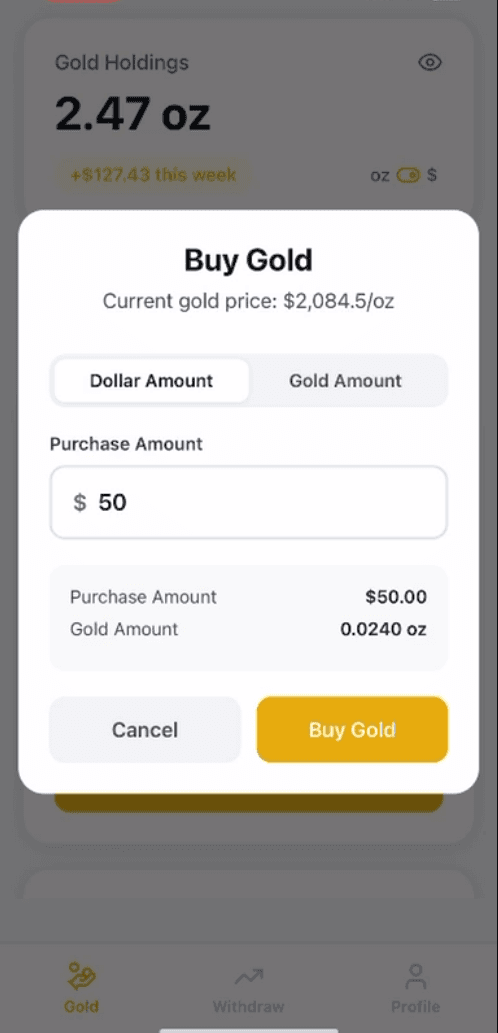
When you buy gold through Aure, you're paying spot price—the actual, real-time market price of gold. Not some inflated "retail price" with a 10% dealer markup. Not some complicated fee structure buried in the fine print. Just honest, transparent pricing that lets you buy gold the same way institutional investors do.
This matters more than you think. That dealer markup? It means you're starting in the hole before your investment even has a chance to appreciate. With Aure, every dollar you invest goes directly into actual gold. When gold hits $4,500 or $5,000 per ounce as analysts predict, you benefit from the full upside—not just whatever's left after someone else takes their cut.
Micro-Savings Through Roundups (Your Spare Change Builds Wealth)
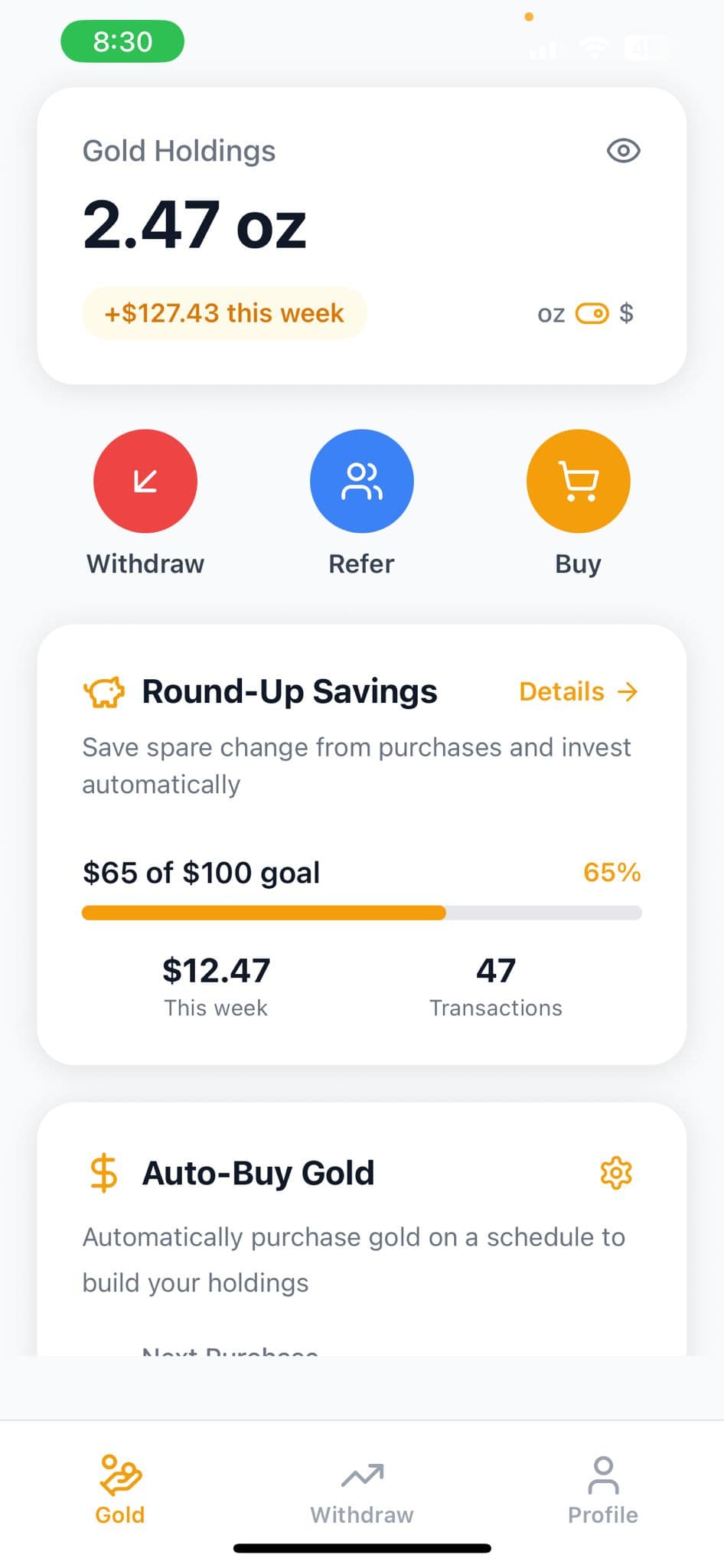
Here's where it gets cool. Remember all those times you bought a $4.75 coffee and didn't think twice about it? With Aure, we automatically round that transaction up to $5.00 and invest the $0.25 in gold. It's invisible. Painless. Automatic.
This isn't some gimmick—it's behavioral finance working for you instead of against you. Traditional banks love when you mindlessly spend because they profit from transaction fees and overdrafts. We're taking that same spending pattern and turning it into wealth accumulation. Your daily habits—grabbing lunch, buying gas, shopping online—become the foundation of your gold portfolio without you having to think about it.
Do the math: If you make 100 transactions a month with an average roundup of $0.50, that's $50 going into gold every month. Over a year, that's $600. If gold appreciates like analysts predict it will—potentially reaching $6,000+ by 2026—your accumulated roundups could be worth significantly more. You're literally building wealth while living your normal life.
Auto-Save Features (Set It and Forget It)
Life gets busy. You forget to transfer money to savings. You put off that investment account. Meanwhile, your bank is happy to keep your money earning them interest while you get nothing. Aure's auto-save feature solves this by letting you set rules that automatically invest in gold based on your preferences.
Maybe you want to invest $25 every week. Or $100 on the first of every month. Or a percentage of every paycheck that hits your account. You set it once, and Aure handles the rest. This is what real financial automation looks like—not some bank trying to auto-enroll you in a checking account with monthly fees.
The beauty of auto-save is that it removes emotion and procrastination from the equation. You're not trying to "time the market" or waiting for the "perfect moment" to invest. You're dollar-cost averaging into gold systematically, which historically smooths out volatility and builds positions over time. When gold dips, you buy more. When it rises, you benefit. Simple.
The Bigger Picture: Financial Freedom on Your Terms
This isn't just about gold. It's about rejecting a financial system that's designed to keep you small. Banks want you dependent—dependent on their loans, their fee structures, their permission to access your own money. They want you just comfortable enough to stay, but never wealthy enough to leave.
Aure Gold is about opting out of that game entirely. It's about taking control of your financial future with an asset that's stood the test of time, but accessing it in a way that actually makes sense for how you live your life. No gatekeepers. No hidden fees. No BS.
The traditional banking establishment doesn't want you buying gold because they can't profit from it. They'd rather keep you trapped in their ecosystem, paying fees on money that's losing value to inflation, while they invest your deposits and keep the returns for themselves.
We're giving you a better option. One where your money works for you, where you own a real asset with intrinsic value, and where building wealth doesn't require choosing between living your life and securing your future.
Your Move
Here's the thing banks don't want you to know: You don't need their permission to build wealth. You don't need a massive income or a huge lump sum to get started. You just need to start—with whatever you have, right now.
Gold is at historic highs and showing no signs of slowing down. Central banks are buying. Institutional investors are loading up. Meanwhile, traditional savings accounts are still paying you essentially nothing while inflation quietly erodes your purchasing power.
The window is open, but it won't stay that way forever. As more people wake up to how badly traditional banks have been playing them, demand for accessible gold investing will surge. Early movers win. Hesitators watch from the sidelines.
Aure Gold launches soon, and early access goes to people who want it most. This is your chance to flip the script on traditional banking, to build real wealth on your own terms, and to own an asset that banks desperately wish you'd ignore.
Ready to join the waitlist? Your financial freedom doesn't need a bank's permission—it just needs you to take the first step.