
Gold as a 2025 Portfolio Diversifier: Beat Stock Volatility with Spot Microsavings


Introduction
Remember when checking your stock portfolio used to feel exciting rather than anxiety-inducing? If you've been watching the market this year, you know exactly what we're talking about. One day the S&P 500 hits new highs, the next it's plunging into correction territory—April's volatility rivaled pandemic-era chaos. Meanwhile, gold quietly climbed past $4,200 per ounce, gaining over 60% year-to-date. Here's the thing: while your tech stocks are riding the AI hype rollercoaster, gold has been doing what it does best—protecting wealth when uncertainty strikes.
In this post, we'll break down why gold's having its best year since 1979, how stock market volatility is pushing smart investors toward diversification, and exactly how you can add gold exposure through small, spot purchases—no vault required.
Chart unavailable
Why Gold's 2025 Performance Is Actually Historic
Let's talk numbers. Gold rose nearly 26% in the first half of 2025 alone, recording 26 new all-time highs. By early December, the precious metal was trading around $4,200-$4,250 per ounce, up from roughly $2,600 at the start of the year. That's not just good performance—it's exceptional.
What's driving this surge? Three major forces:
- Trade policy uncertainty: Trump's tariff announcements in April triggered what the St. Louis Fed called "extreme volatility" across financial markets. When global trade patterns shift overnight, investors flee to safety.
- Persistent inflation: Despite the Fed's efforts, inflation hit 3% in September 2025—still above the 2% target. Gold thrives when your purchasing power is under attack.
- Ballooning national debt: The U.S. national debt surpassed $38 trillion in October, with interest payments alone exceeding $1 trillion annually. This fiscal pressure creates structural support for gold prices.
Real talk: when was the last time you saw an asset class deliver 60%+ gains while stocks were gyrating wildly? Gold's not just performing well—it's reminding everyone why "safe haven" isn't just marketing speak.
The Stock Market Volatility Reality Check
If you've felt whipsawed by the market this year, you're not imagining things. The S&P 500 experienced its worst day since August in March, dropped into correction territory in April, then posted one of its largest single-day rallies (9.4%) in modern history. Intraday volatility hit levels not seen since late 2022.
Here's what's making stocks so jumpy:
Tariff whiplash: April's "Liberation Day" tariff announcement caused a global market meltdown, forcing debt holders to sell U.S. Treasuries and spiking yields. The 90-day pause restored some calm, but uncertainty lingers.
AI bubble concerns: The Magnificent Seven stocks generated 53.7% of the S&P 500's 2024 return, creating unprecedented concentration. What happens when the AI hype corrects?
Fed policy uncertainty: After cutting rates aggressively, the Fed is now caught between sticky inflation and economic concerns—and markets hate uncertainty.
For Millennials and Gen Z investors who've only known the post-2009 bull market (minus COVID), this volatility feels new. But here's the uncomfortable truth: traditional 60/40 portfolios stopped working as expected in 2022, with bonds and stocks moving together instead of inversely. You need actual diversification, not just different types of stocks.
Why Diversification Matters More Than Ever
Picture this: You're 28, diligently putting 15% of your paycheck into your 401(k), all in index funds. You've read the blogs, you're "diversified" across large-cap, mid-cap, and international stocks. Then April 2025 happens, and you watch 10% of your portfolio evaporate in days. Sound familiar?
The problem isn't that you're doing something wrong—it's that your "diversification" is really just different flavors of the same risk. When tech wobbles, your growth funds wobble. When trade wars heat up, all equities suffer together.
Gold offers something fundamentally different. The World Gold Council's research shows that gold's performance is driven by distinct factors: risk & uncertainty, economic expansion concerns, and opportunity cost. When stocks zig, gold often zags—not always, but enough to smooth out your portfolio's roughest edges.
Consider what happened in Q1 2025: Gold gained 20% and broke above $3,000 for the first time while the S&P experienced wild swings. In Q2, as tariff fears intensified, gold ETF flows hit their highest semi-annual levels since early 2020.
Even central banks get it. Global central banks have been buying gold at a robust pace despite record prices, with purchases remaining well above pre-2022 averages. If the institutions managing trillions are diversifying into gold, maybe retail investors should pay attention.
The Debt and Inflation Double Whammy
Let's connect two uncomfortable dots: massive government debt and persistent inflation.
The U.S. is now spending $104 billion in the first nine weeks of fiscal 2026 just on debt interest—that's more than $11 billion per week, representing 15% of all federal spending. With the national debt increasing by roughly $6 billion per day, fiscal pressure isn't going anywhere.
Here's why this matters to you: When governments drown in debt, they have limited options. They can cut spending (politically difficult), raise taxes (also unpopular), or let inflation slowly erode the real value of that debt (the quiet choice). Guess which one usually wins?
Inflation rose to 3% in September, driven by surging energy costs and sticky service-sector prices. Core inflation remains stuck around 3%—fifty percent above the Fed's target. Your savings account earning 4% sounds great until you realize you're barely keeping pace with price increases, and that's before taxes.
Gold doesn't pay interest or dividends, but it doesn't need to. Over long periods, it maintains purchasing power as currencies depreciate. When you're 25 with 40 years until retirement, preserving wealth against inflation is just as important as growing it—maybe more so if we're entering a period of higher structural inflation.
How Spot Buying and Micro-Savings Work Together
Okay, so gold makes sense as a diversifier. But dropping thousands on a single ounce feels impossible when you're juggling student loans, rent, and trying to build an emergency fund. Here's where modern gold investing gets interesting.
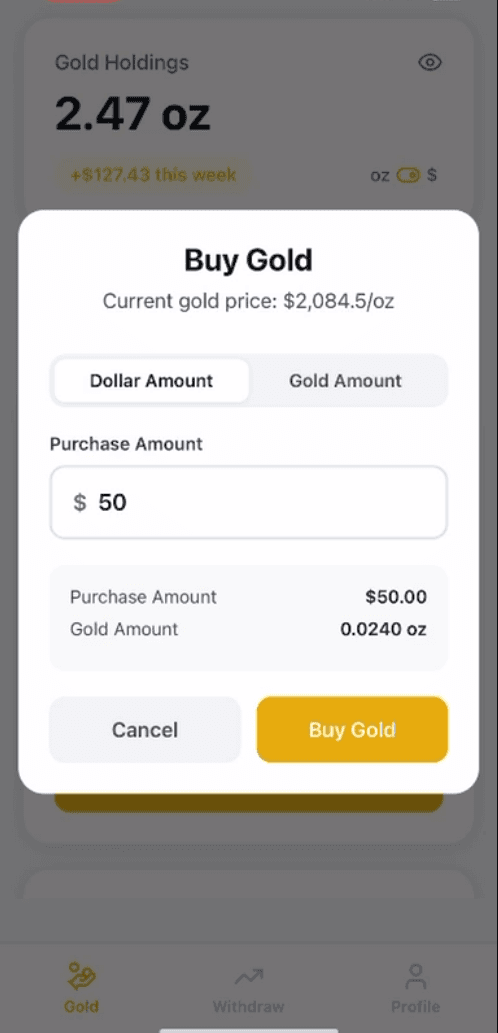
Spot buying means purchasing gold at the current market price—no premiums for collectible coins, no markup for "rare" bars. You're buying the actual metal's value, period. When gold dips to $4,150 and you think it's a good entry point, you can grab some. When it hits $4,300 and you want to lock in gains, you can sell at spot price.
Micro-savings change the game completely. Instead of needing $4,200+ for a single ounce, you can:
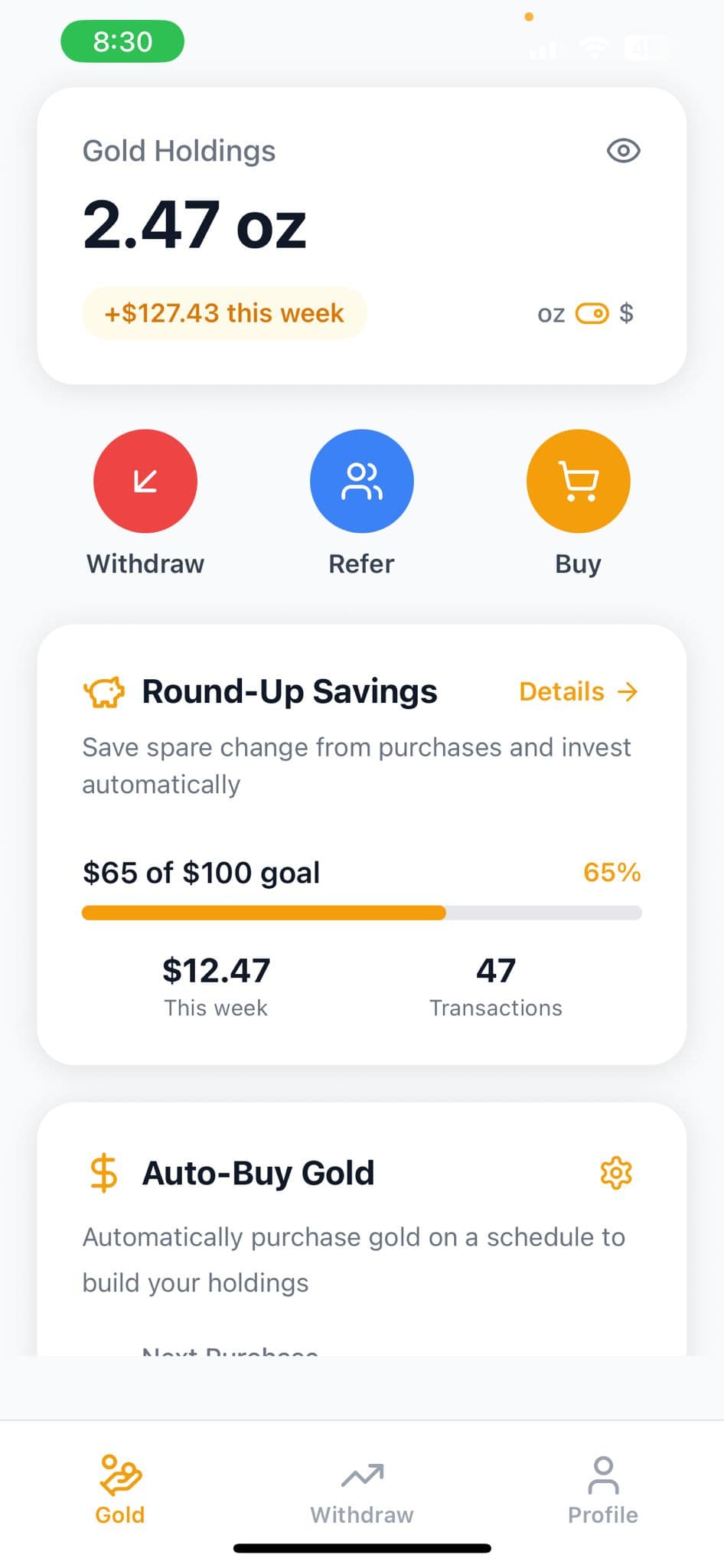
- Round up everyday transactions to the nearest dollar and invest the difference in gold
- Set automatic weekly purchases of $10, $25, or whatever works for your budget
- Dollar-cost average into gold without thinking about it
Real-world example: You buy coffee for $4.75. The app rounds up to $5.00 and invests $0.25 in spot gold. Over a month, those roundups might total $15-30—painless amounts that add up. In a volatile year like 2025, those tiny purchases at different price points smooth out your entry, catching the dips automatically.
This isn't about getting rich quick. It's about building a position in an asset that's gained 60% this year while stocks have been on a wild ride. Even if you only allocate 5-10% of your investable funds to gold, that's often enough to meaningfully reduce portfolio volatility.
Making It Work: Practical Gold Allocation Strategies
So how much gold makes sense? Financial advisors traditionally recommended 5-10% of your portfolio in precious metals. In 2025's environment—with stocks concentrated in a few mega-cap names, bonds behaving strangely, and inflation sticky—some experts suggest the higher end of that range.
The beginner approach: Start with roundup savings and small automatic purchases. If you're investing $500/month across your portfolio, allocating $25-50 to gold via auto-save gives you 5-10% exposure. Set it and forget it.
The opportunistic approach: Keep a small gold allocation running automatically, then make larger spot purchases during dips. When gold pulled back to around $3,900 in late October, that was a buying opportunity. The next one could be around the corner.
The balanced approach: Combine micro-savings with strategic spot buys. Your roundups and small weekly purchases happen on autopilot, building your position consistently. Meanwhile, you stay informed about major market events—Fed announcements, geopolitical developments, debt ceiling drama—and make targeted purchases when prices retreat.
What about timing? Here's the truth: nobody consistently times the market perfectly, whether that's stocks or gold. But dollar-cost averaging through automatic purchases eliminates the pressure to nail the perfect entry. Some weeks you'll buy at $4,100, some at $4,250. Over time, you'll average out somewhere in the middle—and in a year where gold's up 60%, that middle is looking pretty good.
The key is starting. Markets don't wait for perfect conditions, and neither should you.
Why This Moment Matters
We're at an interesting inflection point. Gold-backed ETF holdings added 638 tonnes in 2025, bringing total assets to 3,857 tonnes—just 2% below the November 2020 peak. Professional investors are piling in, recognizing what's happening.
Meanwhile, most retail investors remain underweight in gold. The average 20-something's portfolio looks like: 90% stocks, 5% bonds, 5% cash. Zero commodities. Zero precious metals. Maximum exposure to equity market volatility.
You don't need to become a gold bug predicting the collapse of fiat currency. You just need to acknowledge that when stocks deliver wild daily swings, when inflation runs hot, when governments accumulate debt at unprecedented rates, having 5-10% of your wealth in something that's been valuable for 5,000 years isn't crazy—it's prudent.
The beauty of modern micro-savings and spot buying is that you don't need to make a massive commitment upfront. Start small. See how it feels. Watch how your overall portfolio becomes a bit more stable when you have some gold exposure.
Looking Ahead: What Early Access Means for You
Here's what gets us excited: the ability to make gold investment as easy as buying a latte. Fractional ownership through spot purchases, automated saving that happens in the background, real-time pricing without dealer markups or collectible premiums.
The features coming down the pipeline make this even more compelling:
- Advanced portfolio tracking that shows exactly how gold is reducing your overall volatility
- Tax-loss harvesting opportunities (yes, even with gold)
- Educational content that helps you understand exactly what drives gold prices
- Community features where you can see how others are allocating and learn from their strategies
Most importantly: early access for users who join now. While gold's having its moment in 2025, getting positioned before the next wave of investors pile in could be the difference between averaging in at $4,200 vs. $4,500+.
The Bottom Line
Stock volatility isn't going away—not with AI valuations stretched, trade policy uncertain, and inflation sticky. The World Gold Council projects continued robust demand from central banks, elevated ETF flows, and structural support from macro uncertainty.
You've got two choices: keep riding the stock market rollercoaster alone, or add an asset that's proving its diversification value in real-time. With spot buying and micro-savings, you can start building gold exposure with the spare change from your daily coffee run.
The investors who look back on 2025 and feel satisfied won't be the ones who timed the market perfectly. They'll be the ones who built balanced, diversified portfolios that could weather whatever came their way—tariff wars, inflation scares, debt ceiling drama, all of it.
Gold's not magic. It won't make you rich overnight. But in a year when it's outperformed stocks while providing stability? It's doing exactly what a diversifier should do.
Ready to add gold to your portfolio without needing thousands upfront? Join the waitlist for early access to spot buying, automatic roundups, and the easiest way to diversify beyond stocks. Your future self—the one watching the next market correction with a bit less stress—will thank you.